
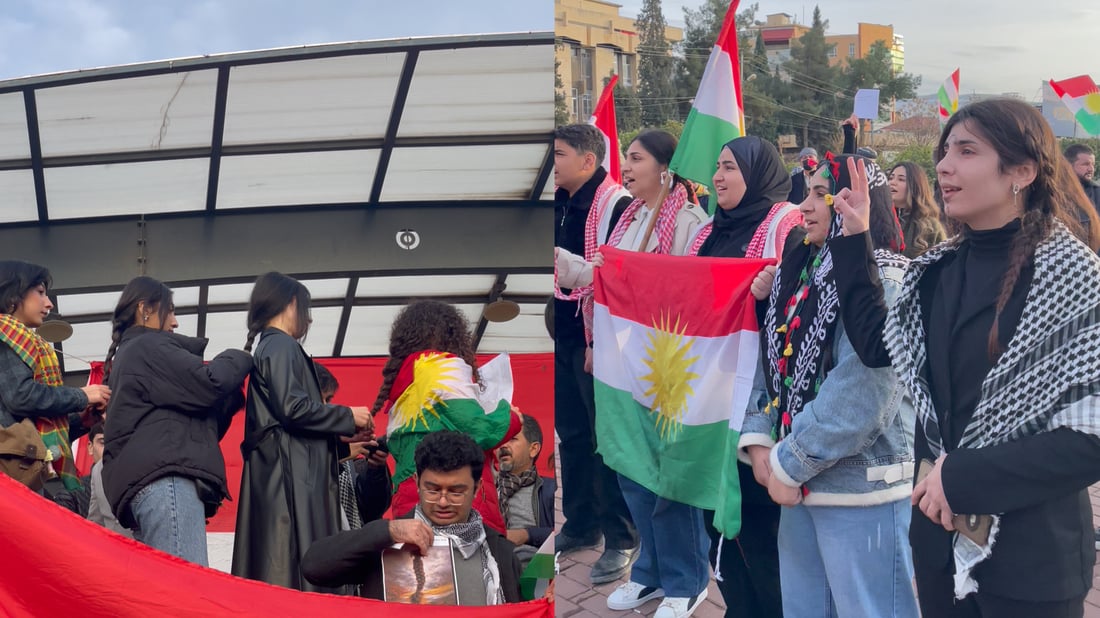
Duhok residents protest against assaults on Kurds in Rojava, Syria. (Photo: 964media)
'This braid is our flag'
Duhok protesters call for global support as Syria’s Kurds face onslaught
DUHOK — Protests in support of Kurds in Rojava, northeastern Syria, continued Saturday in the city of Duhok, joining a wave of demonstrations across the Kurdistan Region of Iraq and abroad condemning assaults by Syrian government forces and affiliated armed Islamist groups.
Participants chanted slogans emphasizing Kurdish unity and resistance, including “Rojava to Rojhalat, Kurdistan is one nation,” linking Syrian Kurdistan with eastern Kurdistan in Iran as part of a shared national identity.
Others sang lines from “Kîne Em?” or “Who Are We?”, a song long associated with Kurdish cultural and national expression and popularized by singer Şivan Perwer.
Children also took part in the demonstration. One boy told 964media in English, “Today we are all here to help our country. We are Kurds. Kids in Rojava are dying for no reason. I am speaking here to show Trump what is happening in Rojava. Many people are getting killed there by those bad people. We need help from you and other countries. Kurdistan is one.”
Young women at the rally braided their hair in a symbolic act of solidarity, echoing similar gestures across the Kurdistan Region and the Kurdish diaspora. The act references a widely circulated video showing a supposed pro-government Syrian militant claiming to hold up a braid cut from the hair of a slain Kurdish woman.
The video shows a man entering a room holding a long braid and mocking its origin while speaking to another man off-camera. “This is the hair of a haval,” he says, using the Kurdish word for friend or comrade. When asked why the hair was cut, he replies, “She was already dead.”
“This braid is our flag,” some protesters said.
In Kurdish culture, braided hair is widely regarded as a symbol of dignity and strength for women. Cutting it from a dead woman is seen not only as an act of brutality but also as a profound cultural violation.
In response to the video, Kurdish women around the world have launched a hair-braiding campaign, posting videos of themselves braiding their hair in solidarity with the victim and in protest against ongoing violence against Kurds in Rojava.