
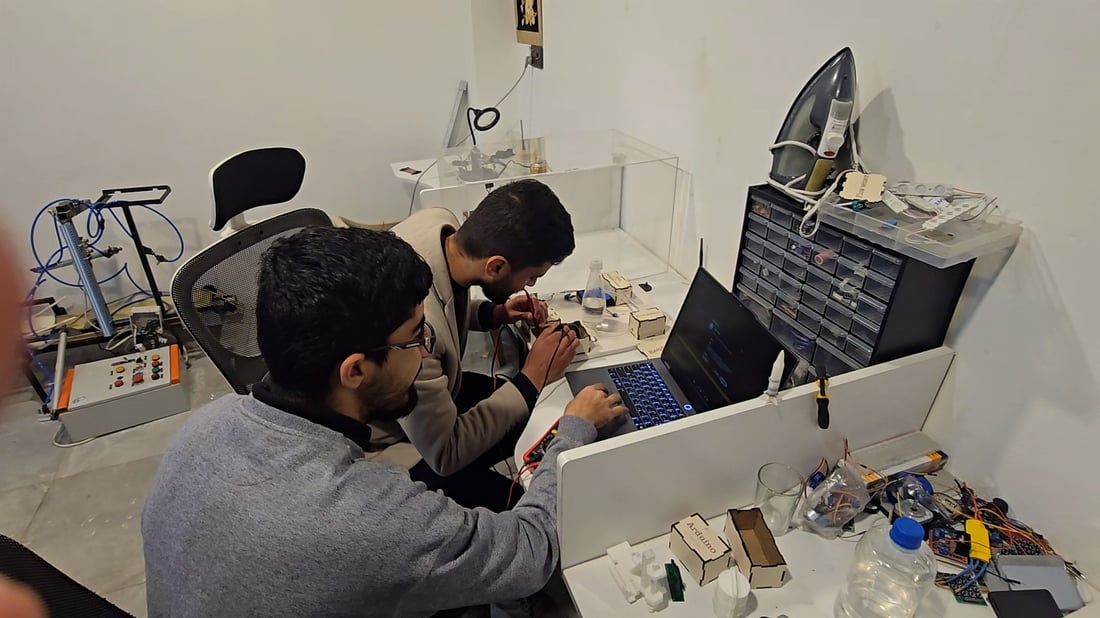
Programmers work on AI-based devices at the “Nawa” Electronics Center in Mosul, Nineveh governorate. Photo by 964media.
Mosul programmers develop tools for refinery monitoring, cybersecurity
MOSUL — Two young programmers in Mosul have developed artificial intelligence-based tools aimed at monitoring oil refinery operations and detecting cyber intrusions, projects they say could predict risks before they occur and reduce reliance on manual monitoring.
Programmer Mohammed Hassan created a device that tracks oil pumping operations inside refineries and uses artificial intelligence to flag potential risks in advance. His colleague at the Nawa Electronics Center, Yahya Ali, developed a system that monitors internet networks for hacking and infiltration attempts by tracking router activity and identifying unusual movements, members of the center told 964media.
The projects are being developed at the Nawa Electronics Center, which opened about a year and a half ago in the Majmouat al-Thaqafiya area on Mosul’s east side. The center employs 10 engineers and specialists in programming, technology and electronic engineering and works to attract innovators and help them turn ideas into workable projects.
Hassan told 964media that his device monitors refinery pump operations and forecasts risks that could threaten pumping activity before they happen.
He said the device detects vibration and records pumping, temperature and humidity readings, then transmits the data to an AI-based system that analyzes it and logs predictive alerts. He said the aim is to prevent failures before they occur, which “enables refineries to dispense with many human cadres working in pump monitoring.”
Ali told 964media that his intrusion-detection system monitors routers and detects “any strange movement in the network.”
He said the team is focusing on three types of attacks: injection, DDoS and brute force. Ali said the program still needs more network data to train an AI model capable of reliably detecting intrusions.
Abdul Karim Ahmed, director of the Nawa Center, told 964media that the idea for the center grew out of what he described as “the days of university struggle,” when students had trouble accessing workshops and equipment needed to build and test projects. After graduating, he said, the founders opened the center to support students and innovators.
Ahmed said the center has partnered with the United Nations to provide a workspace equipped with tools and machinery, including lasers and 3D printers. Since opening, he said, the center has trained 100 young people in programming, development, cybersecurity and entrepreneurship, with 60 trainees successfully designing innovations and receiving support, equipment and implementation requirements.
He said the center is also working to link technology with education by teaching programming and artificial intelligence to primary school students. Ahmed said the center is preparing a project, pending approval from the Ministry of Education, to make those subjects part of the core curriculum, noting that computer education in schools currently begins later at the intermediate level.