
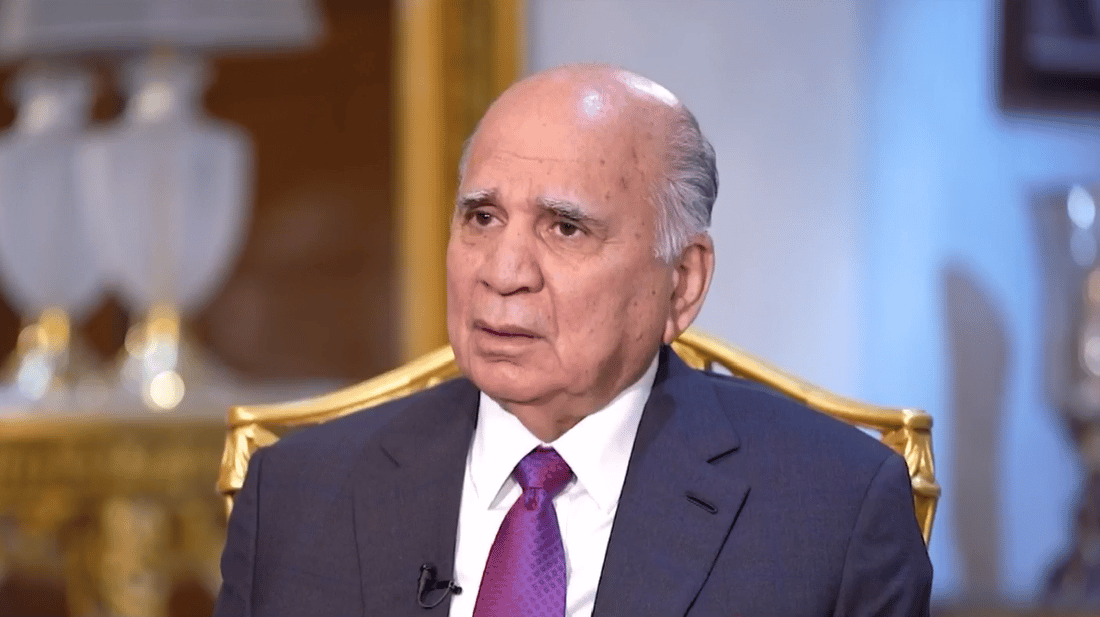
Iraq’s Foreign Minister Fuad Hussein speaks during an interview
Media Monitor
Iraq FM: US will not deal with ministries linked to sanctioned figures
BAGHDAD — Foreign Minister Fuad Hussein said the United States has delivered clear messages that it will not deal with Iraqi ministries linked to groups or individuals on Washington’s sanctions list.
In an interview with Al Sharqiya News, Hussein said American officials “give these signals to those on the sanctions list,” adding, “it is difficult for us to deal with them. They are acting based on U.S. law that prohibits dealing with individuals or parties that are on the sanctions list.”
When asked whether the next government could include ministries tied to armed factions, he said, “I don’t know. We are in the stage of negotiations and dialogue.” He added that parties must balance “the country’s interest” with political interests when forming a cabinet.
Excerpts from Fuad Hussein’s interview on Al Sharqiya News:
Question: We are on the verge of forming a government. Are there American messages calling for keeping sovereign and non-sovereign ministries away from groups that have armed wings?
Fuad Hussein: They give these signals “to those on the sanctions list.” It is difficult for us to deal with them. They are acting based on U.S. law that prohibits dealing with individuals or parties that are on the sanctions list.
Question: Do you expect a government to be formed that includes ministries belonging to armed factions?
Fuad Hussein: I don’t know. We are in the stage of negotiations and dialogue. How the next government will be formed—I honestly don’t know.
Question: If a government is formed with ministries linked to armed factions, what are the consequences?
Fuad Hussein: This is hypothetical. I think all parties and representatives of all components are aware of this information. How to handle it and how to create a balance between the country’s interest and the interest of a party or faction—this is something that must be taken into account.
Question: During the past two weeks, we heard many claims. Some said six factions would not participate in the next government. A U.S. delegation visited Iraq recently and refused to deal with ministries belonging to groups with armed wings. How accurate is that?
Fuad Hussein: I also heard a lot, but in reality they have already announced these matters. Just as they announced the names of individuals and banks, they also announced the names of the factions. They said these are on the sanctions list, and when you are on the sanctions list they will not deal with you according to U.S. law.
Iran’s interest requires Iraq to be a neighboring and friendly state. “We are not used to being followers,” and no one accepts being a follower. I don’t think many Iranians want that either, but we must change our mindset inside Iraq.
The next president cannot be a neutral or independent person. The next president—whether prime minister, parliament speaker, or president of the republic—must rely on a force that supports them, whether it is a party, a group of parties, or even an entire component. We need strong leaders in the coming phase.
As a Foreign Ministry, we welcome Mark Savaya, the U.S. president’s special envoy to Iraq, because I believe this envoy will report directly to the White House, which will make relations with Washington easier and will help deliver information more quickly.
We need the United States and we need to protect Iraqi-U.S. relations. We start from Iraqi interests, and we have important shared areas with them in the Iraqi economy, especially the oil industry.