
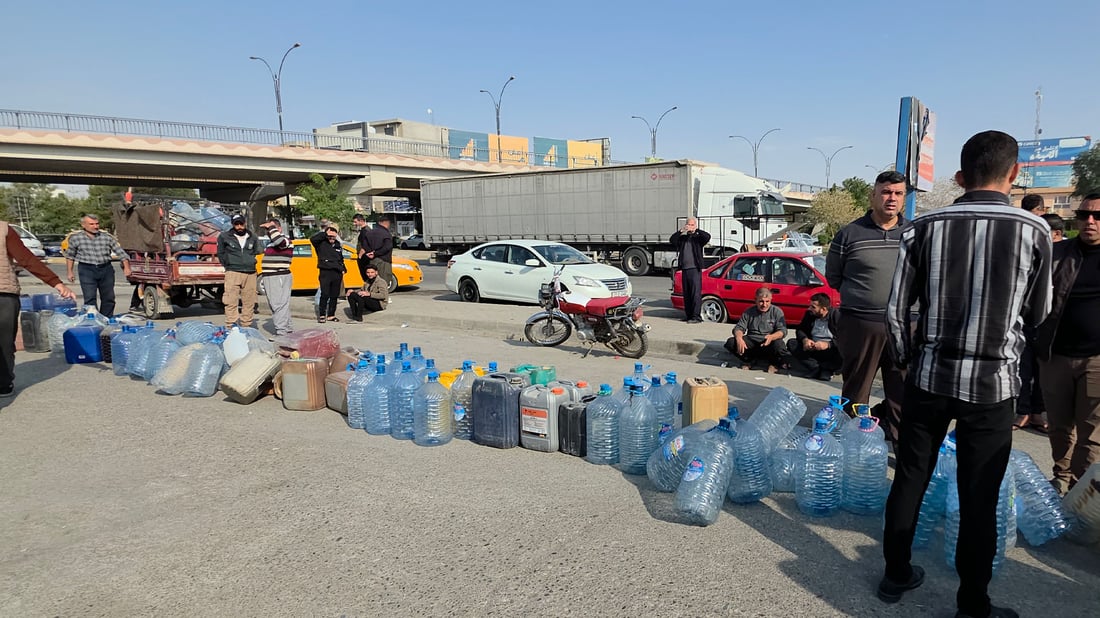
Drivers in Kirkuk line up with plastic containers as fuel shortages leave thousands unable to fill their vehicles.
Fuel shortage in Kirkuki leaves locals queuing with bottles and jerrycans
KIRKUK — A reduction in Kirkuk’s daily gasoline allocation to 1.5 million liters has created shortages of subsidized fuel across the governorate, leaving an estimated 9,000 cars without gasoline every day, according to distribution officials.
A source in the Kirkuk petroleum distribution company told 964media that the supply previously reached “1,950,000 liters from Baghdad, but it has now been reduced to 1,500,000, meaning 450,000 liters less.” The source explained that “if you divide that amount by 50 liters per car, it means 9,000 cars are left without gasoline daily, and this is already causing problems. We are at the beginning of the crisis.”
The source said the Iraqi government and the Ministry of Oil have a renewable agreement with Kuwait every three months to import high-quality super gasoline, which is later blended with Iraqi fuel before being distributed to the 15 governorates. “But now, because Iraq has not renewed the agreement due to a shortage of cash, the decision is to rely on local production,” the source said.
Kirkuk previously received fuel for 90 public and private gas stations, but several have now shut down because of reduced supply. The same source told 964media that about 350,000 cars depend on the coupon system to obtain gasoline.
Muhammad Jasim, an employee at one of Kirkuk’s stations, told 964media that their 24-hour station has also seen its allocation reduced. “We have to distribute fuel quickly, and it finishes early, leaving a large number of people without gasoline,” he said. He added that some stations now receive fuel only once every two days, creating further difficulties for drivers.
In most parts of Iraq, the government distributes gasoline to fuel stations at a subsidized rate, allowing stations to sell it directly to residents at 450 Iraqi dinars (about $0.32) per liter. This state-controlled pricing system is intended to keep fuel affordable for the public, with distribution overseen by the Oil Products Distribution Company to regulate supply across the governorates.