
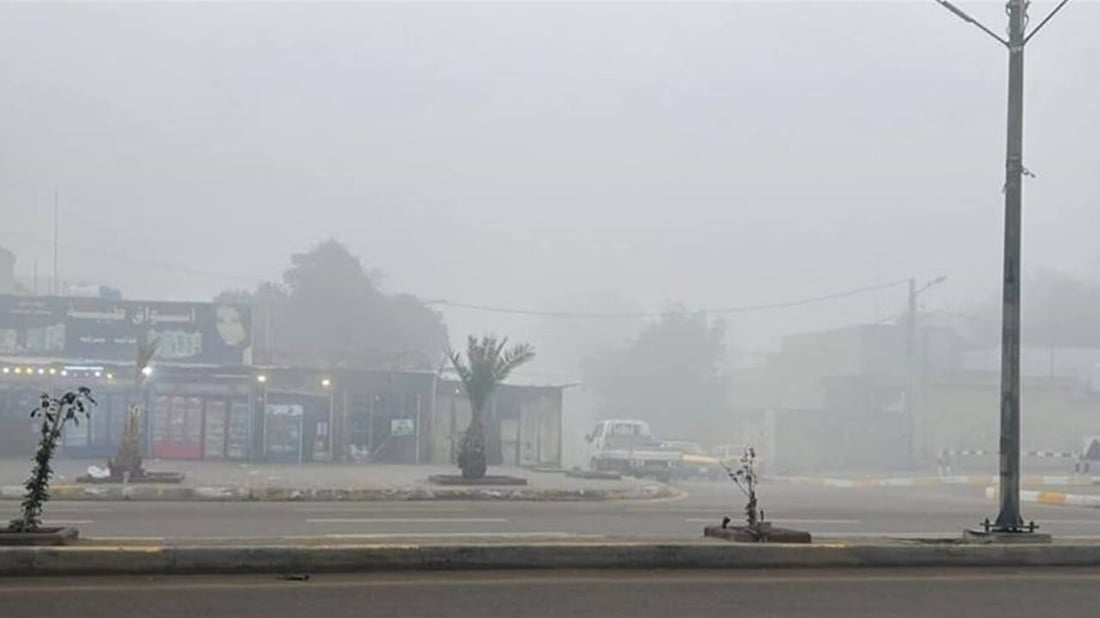
A thick layer of haze blankets a Baghdad street as air quality worsens across the capital.
Iraq Green Observatory warns toxic pollution in Baghdad may spread to nearby governorates
BAGHDAD — Iraq’s Green Observatory has warned that hazardous air pollution in Baghdad is reaching “dangerous” levels and could spread into nearby governorates, saying current conditions pose health risks to the respiratory system, lungs and eyes and may cause nausea and stomach pain.
In its statement, the observatory said recent cloud cover has created “a layer that keeps pollutants close to the surface of the earth.” It reported the presence of nitrogen dioxide in Baghdad’s air, saying the gas “causes eye and respiratory irritation, and long-term exposure leads to cardiovascular diseases.” It added that sulfur dioxide, also recorded in Iraq’s atmosphere, “is an important element of acid rain and causes nausea, vomiting, stomach pain and damage that affects the airways and lungs.”
The observatory said Baghdad’s Air Quality Index often reaches “150 to 200 and higher,” levels classified as unhealthy to very unhealthy, driven largely by fine particulate matter PM2.5. It said the index recently jumped to “380 in one night,” exceeding danger thresholds, and described a “dangerous exceedance” in PM2.5 concentrations. Average PM2.5 in 2024 reached 40.5 micrograms per cubic meter, it said, more than eight times the global limit of 5 micrograms per cubic meter.
It added that it does not rule out the possibility that this pollution “will reach governorates near Baghdad and affect them greatly,” warning of rising contamination and associated health impacts.
Baghdad has struggled with worsening air quality in recent weeks, prompting an emergency meeting chaired by Governor Atwan al-Atwani on Nov. 26. The session brought together representatives from the Ministry of Environment, the governorate’s environment committee and several technical departments to address what officials described as a deepening air quality crisis. Al-Atwani highlighted key pollution sources, including the waste dump at the Rashid Camp site, the Nahrawan landfill, brick factories and widespread waste burning inside residential areas.
He warned that negligent institutions would be held accountable and said the governorate would submit a detailed report to the prime minister to push for stricter enforcement and oversight.
An atmospheric physics researcher told 964media that the choking haze over Baghdad is the result of a complex interaction between a natural thermal inversion and rising nitrogen dioxide levels linked to fossil fuel combustion. Aqeel Ghazi Matar said the recent fog-like layer forms when this invisible gas reacts with sunlight and humidity to produce aldehydes, organic compounds that give the horizon a gray-brown tint and a sharp odor similar to “a burning matchstick.”
Matar said thermal inversion, which occurs during autumn nights when warm daytime temperatures meet cooler nighttime air, is a long-standing natural phenomenon that traps pollutants near the ground. “This phenomenon has a God-given system to disperse pollutants, and this mechanism stops when a thermal inversion occurs,” he said. He noted that nitrogen dioxide levels have increased over the past 20 years due to the burning of gasoline, diesel, oil and gas. When exposed to sunlight and sufficient humidity, he said, NO2 becomes unstable and transforms into aldehydes that spread at daybreak.
He said monitoring has revealed a constant pollution hotspot southwest of Baghdad operating around the clock. The affected zone forms a triangle from Basmaya to Dora and toward the outskirts of Karbala.
“Is it possible that this area has more cars than Baghdad? Of course not,” he said, suggesting that something “more dangerous than vehicles” is driving the persistent emissions.