
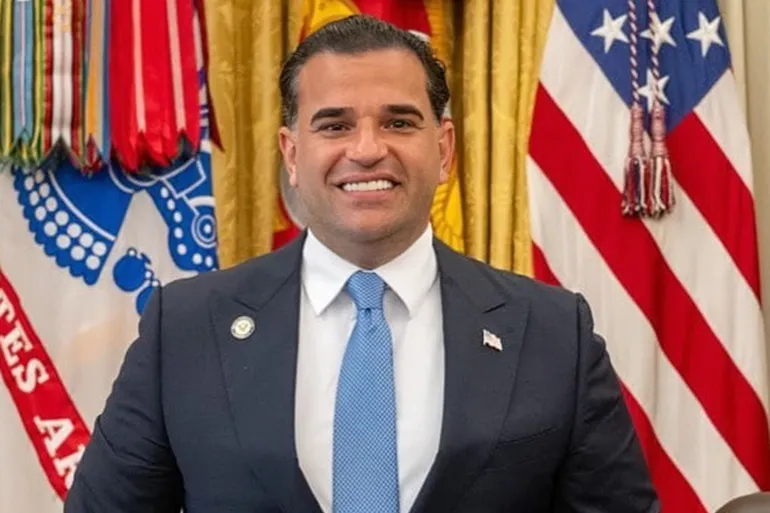
U.S. Special Envoy to Iraq Mark Savaya
Mark Savaya
US envoy says Iraq has ‘historic opportunity’ to disarm non-state groups
BAGHDAD – U.S. Special Envoy to Iraq Mark Savaya said Iraq has a “historic opportunity” to disarm non-state actors and reinforce state institutions, linking the effort to recent attacks on the Khor Mor gas field in the Kurdistan Region and warning that weapons outside state control threaten the country’s stability and economy.
“Today, the world views Iraq as a country capable of playing a larger and more influential role in the region, provided that the issue of weapons outside state control is fully resolved and the prestige of official institutions is protected,” Savaya said in a post on X, formerly Twitter.
He warned that no economy can grow “in an environment where politics is intertwined with unofficial power,” stressing a need to end the role of armed groups in political life. “Iraq now has a historic opportunity to close this chapter and reinforce its image as a state built on the rule of law, not the power of weapons,” he said.
Savaya’s comments come amid ongoing reactions to the latest drone strike on the Dana Gas operated Khor Mor field in Sulaymaniyah, which has been targeted multiple times since 2022. The most recent attack triggered a shutdown in gas supplies and widespread power outages across parts of the Kurdistan Region, including Erbil and Sulaymaniyah.
The envoy called for support for Iraq’s constitutional framework, a clear separation of powers and stronger legal accountability. “Strong nations are built when the executive, legislative, and judicial branches operate within their defined boundaries and are held accountable through clear legal mechanisms, not through pressure or influence centers,” he said.
“Iraq stands at a critical crossroads,” Savaya added. “What is needed today is support for the country’s path, respect for the constitution, reinforcement of the separation of powers, and a firm commitment coupled with concrete action to keep weapons out of politics.”
Savaya has repeatedly warned that Iraq’s sovereignty and progress “will remain at risk” unless all security forces operate under government command, saying that external interference and armed groups outside state control continue to threaten stability.
His latest statement comes as debate intensifies over the future of the Popular Mobilization Forces, or Hashd al Shaabi, formed in 2014 to fight the Islamic State group. The PMF is formally part of Iraq’s security structure but includes factions closely tied to Iran that operate with varying degrees of autonomy.
In August, the government withdrew a draft bill to formalize the PMF as a permanent military institution after warnings from rival political blocs and international partners. Parliament had completed the second reading in July, but many Sunni and Kurdish lawmakers walked out in protest over the bill’s inclusion on the agenda without broader agreement.