
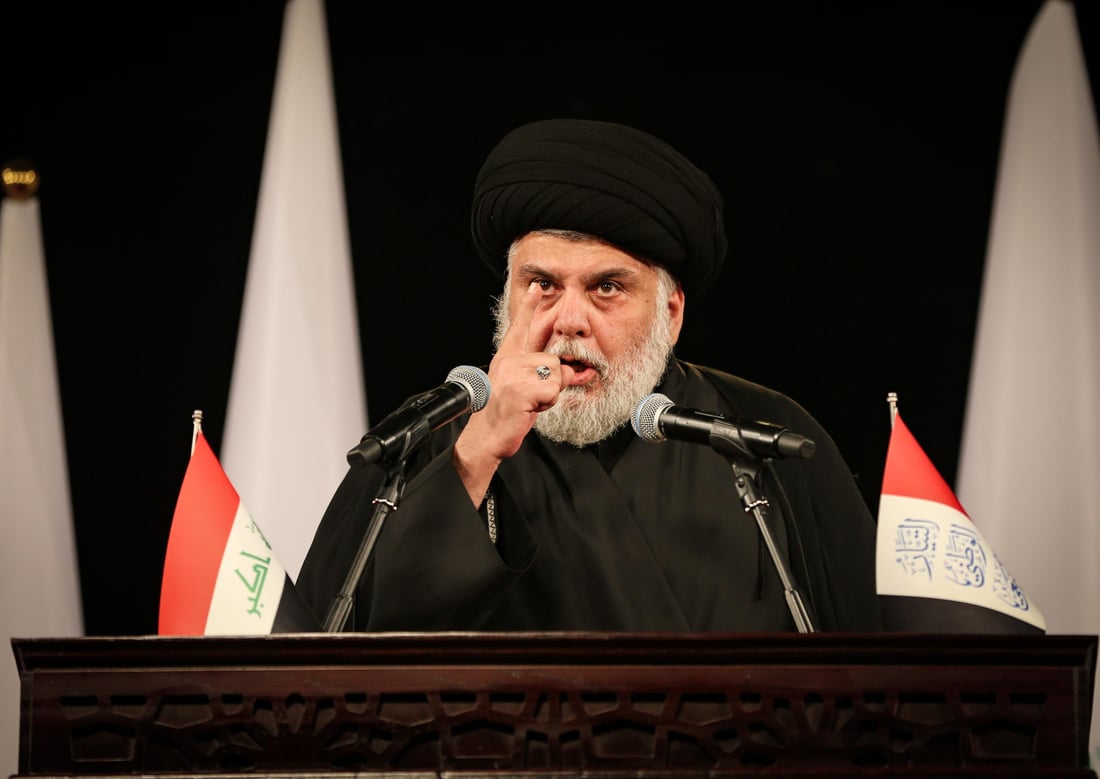
Shiite National Movement leader Muqtada Al-Sadr
‘Deluded’: Sadr rejects Huqooq Movement’s claim of representing his base in Iraq’s elections
BAGHDAD – Shia cleric Muqtada Al-Sadr on Tuesday dismissed claims by the head of the Huqooq Movement, Hussein Moanes, that his party represents the social base of the Sadrist movement in Iraq’s 2025 parliamentary elections, calling the statement false and reaffirming his group’s election boycott.
Moanes, whose Huqooq Movement serves as the political wing of militia group Kataib Hezbollah, made the remarks during a press conference in Baghdad. “Non-participation of the Sadrist movement has left an effect on representation and the political process,” he said. “But the Huqooq Movement and its lawmakers will be the social representatives of the Sadrist movement base, just as the Sadrists were previously representatives of all blocs and components.”
He described the elections as “a battlefield of ballot boxes” and urged public participation.
Sadr responded on his X account, saying, “Anyone from parties, political entities, or individuals claiming our support in this election is lying. Whoever believes them is either deluded or an infiltrator with no relation to us whatsoever.”
He reaffirmed his movement’s decision to stay out of the vote. “We will not join them in their corruption, their dependency, or their uncontrolled weapons,” he said.
The Huqooq Movement’s claim appeared aimed at attracting Sadrist supporters to vote for its candidates in the absence of formal participation by the movement.
Yesterday, Sadr renewed his call for an election boycott, urging followers to abstain from voting. “Boycott them, may God have mercy on you,” he said in a statement posted online. He also cited a Quranic verse: “My Lord, do not place me among the corrupt people.”
Earlier Tuesday, the Independent High Electoral Commission reported voter turnout of 23.9% by midday, with 4,795,685 ballots cast out of 20,063,773 registered voters. Turnout in recent general elections has been low, with 44.5% participation recorded in 2018 and 41% in 2021 — a figure widely seen as inflated because it reflects only voters registered with biom, not the total eligible population.