
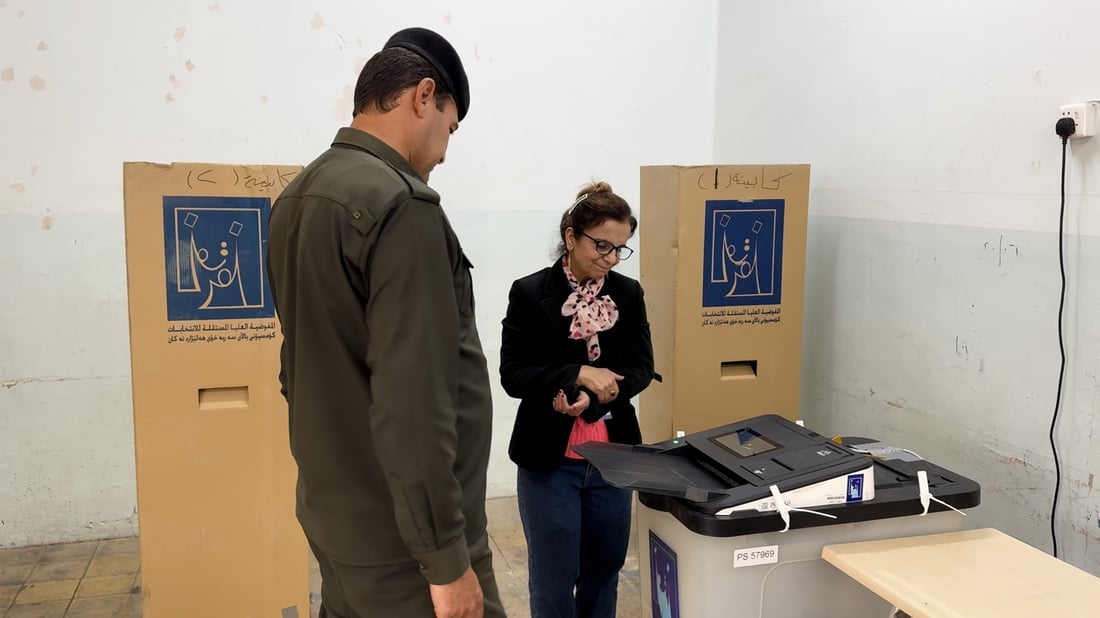
IHEC reports 82.5% turnout in Iraq’s special vote, with Sulaymaniyah leading participation
BAGHDAD — Iraq’s Independent High Electoral Commission on Sunday released its final report on the special voting process, showing an overall turnout of 82.52% among eligible participants, with more than 235,000 voters not casting ballots.
The commission said 1,084,289 members of the security forces voted out of 1,313,980 registered, while 20,527 displaced voters participated out of 26,538 eligible. That left 229,691 security personnel and 6,011 displaced persons who did not vote, for a total of 235,702 nonvoters.
Among participants, the report recorded 1,082,052 men and 22,764 women.
Turnout rates by governorate were: Baghdad–Rusafa (70.37%), Duhok (91.66%), Erbil (97.79%), Sulaymaniyah (98.16%), Nineveh (87.20%), Kirkuk (84.15%), Diyala (87.21%), Anbar (75.29%), Baghdad–Karkh (78.23%), Babil (82.67%), Karbala (78.04%), Wasit (75.42%), Salah al-Din (75.64%), Najaf (72.00%), Qadisiyah (81.24%), Muthanna (76.05%), Dhi Qar (82.51%), Maysan (75.64%), and Basra (75.22%).
The highest participation was in Sulaymaniyah at 98.16%, followed by Erbil (97.79%), Duhok (91.66%), Diyala (87.21%), and Nineveh (87.20%). The lowest rates were in Baghdad–Rusafa (70.37%), Najaf (72.00%), Anbar (75.29%), Basra (75.22%), and Wasit (75.42%).
IHEC spokesperson Jumana Al-Ghalai told the Iraqi News Agency that manual and electronic counts matched exactly. “The manual and electronic counting and sorting process for the special vote has been completed, and the results were identical,” she said.
The commission said polling was conducted across all Iraqi governorates, with data collected from every special voting station. Biometric verification was used in 0.67% of total cases, and 8,955 technical issues were resolved during the day. The commission also said it received four complaints from provincial electoral offices.
Prime Minister Mohammed Shia Al-Sudani praised the high turnout after polls closed. “We extend our congratulations to you for exercising your constitutional right through your conscious, active participation in the elections and for choosing your representatives in the upcoming Council of Representatives,” he said. “Let these elections stand as a model of discipline, commitment, and vigilance in defending citizens’ right to freely exercise their constitutional duty.”
Qais Al-Muhammadawi, deputy commander of the Joint Operations Command and head of the Higher Security Committee for Elections, said the process was orderly and secure. “Discipline was high during the special vote, in coordination with the electoral commission,” he said. “We are proud of our role in securing the special voting process.”
The Iraqi Election Monitoring Networks Coalition said 1,841 procedural violations had been recorded by noon, mostly related to group voting, the use of mobile phones inside polling stations, and campaigning during the electoral silence period.
Special voting was held from 7 a.m. to 6 p.m. across Iraq and the Kurdistan Region, allowing 1.3 million security personnel and 26,000 displaced persons to cast ballots ahead of the November 11 parliamentary elections, which feature 7,768 candidates nationwide.