
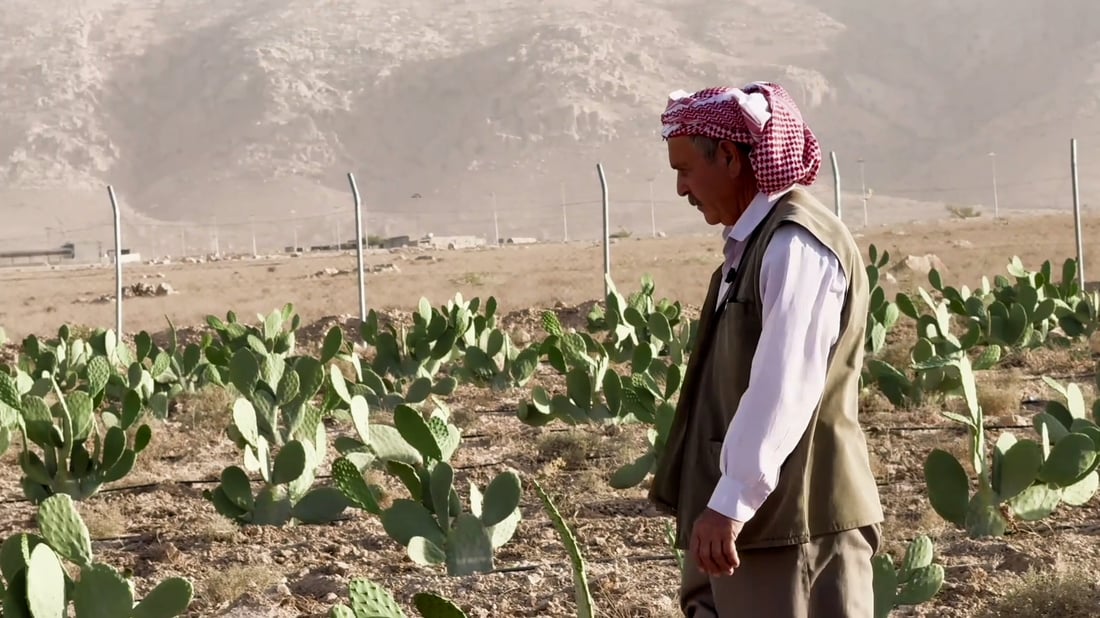
A farmer inspects prickly pear cactus plants in Sinuni, north of Mount Sinjar. Photo by 964media
Sinjar farmers turn to drought-resistant prickly pear in push for sustainable agriculture
NINEVEH — Farmers in the Sinjar district of Nineveh governorate are increasingly turning to the prickly pear cactus, known locally as sabr, as a resilient crop capable of thriving in arid conditions with minimal water requirements.
Shvan Ibrahim al-Omari, a farmer based in Sinuni, told 964media that he has planted 2,000 pads of a Spanish hybrid variety of prickly pear imported from the United Arab Emirates. “The type we plant is hybrid and has almost no thorns, unlike the traditional ornamental cactus,” he said, adding that the crop’s ability to survive high temperatures, strong winds, and drought makes it well-suited to the environment of Sinjar.
Al-Omari said the cactus is planted with “engineering precision,” with two meters between each pad and four meters between rows. The plants are irrigated once a week, though they can survive for up to 10 days without water. “If we want more leaves, we water them more. If we want more fruit, we reduce the water,” he explained.
The farm produced more than 1.2 tons in its first harvest, which was distributed to Baghdad and Erbil, with prices ranging from 4,000 to 5,000 dinars ($2.82–$3.52) per kilogram. “We are now at the start of the second round,” al-Omari said.
In addition to cactus, the farmer is cultivating 2,500 pistachio trees and 3,000 pomegranate trees across 10 donums of land. He called on the government to support the expansion of the project by drilling an artesian well to sustain the crop.
Local observers say the initiative has the potential to diversify agriculture in the region and boost farmer income. With official backing, the drought-resistant cactus could become a key part of Sinjar’s agricultural future.