
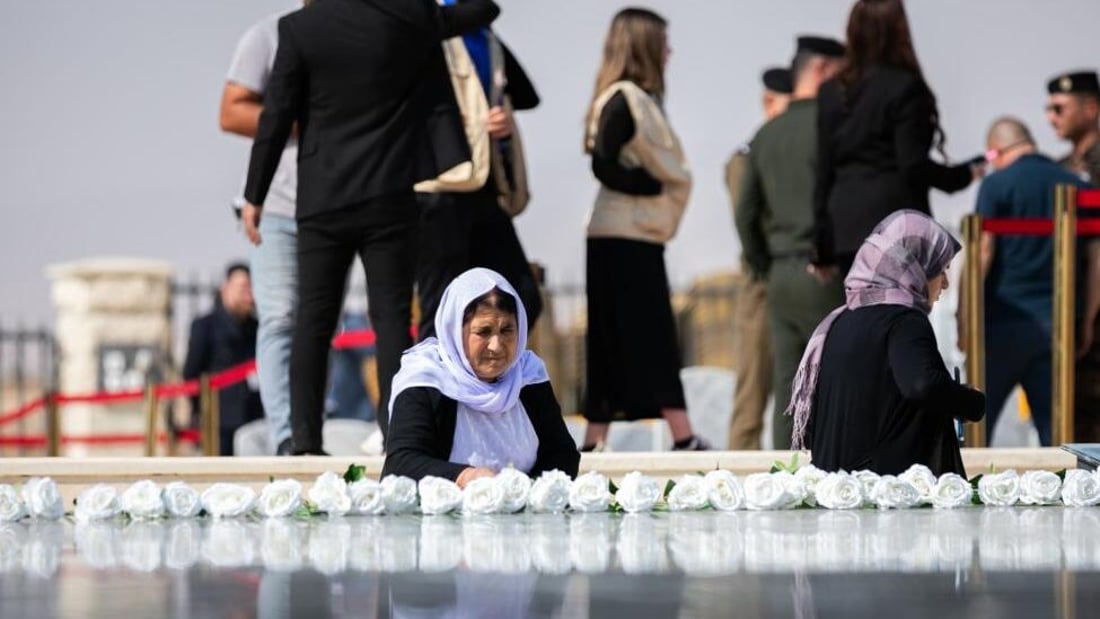
Yazidi women lay flowers in remembrance of victims of the 2014 genocide in Sinjar
Iraq to release secret files on ISIS crimes against Yazidis, court says
BAGHDAD — Iraq’s National Center for International Judicial Cooperation will soon release previously sealed case files on Islamic State militants accused of committing atrocities against the Yazidi community before fleeing abroad, a senior judicial official said.
Iyad Mohsen Damad, deputy head of the Rusafa Court of Appeals, told the state news agency that the center is working with international organizations and foreign embassies to track down and return perpetrators. “In the coming months, much information will be announced and secrecy will be lifted on some files related to major criminals,” he said.
He added that the work involves judicial and diplomatic channels. “So far, there is no official statistic on the number of criminals who committed the crimes and left Iraq,” he said. “Secrecy will be lifted on some files related to major criminals who committed those crimes and fled outside Iraq, during the coming months.”
Damad stressed that Iraq’s general amnesty law does not cover genocide cases. “The punishments issued against those already placed in correctional institutions remain in force, and rulings will also be implemented against those arrested later, where they will be placed in prison to complete their sentence and have the judgments enforced,” he said.
The announcement comes more than a decade after ISIS fighters swept into Sinjar in August 2014, killing thousands of Yazidi men and forcing women and children into captivity. Many women and girls were subjected to sexual slavery, while boys were indoctrinated as fighters. Villages were destroyed and mass graves uncovered, while tens of thousands of Yazidis remain displaced in camps across northern Iraq and abroad.
The United Nations has recognized ISIS’s campaign as genocide. According to UN figures, more than 5,000 Yazidis were killed, about 360,000 were displaced inside Iraq, and more than 100,000 fled the country. The International Organization for Migration reported that up to 80 percent of public infrastructure and 70 percent of civilian homes in Sinjar and surrounding areas were destroyed.