
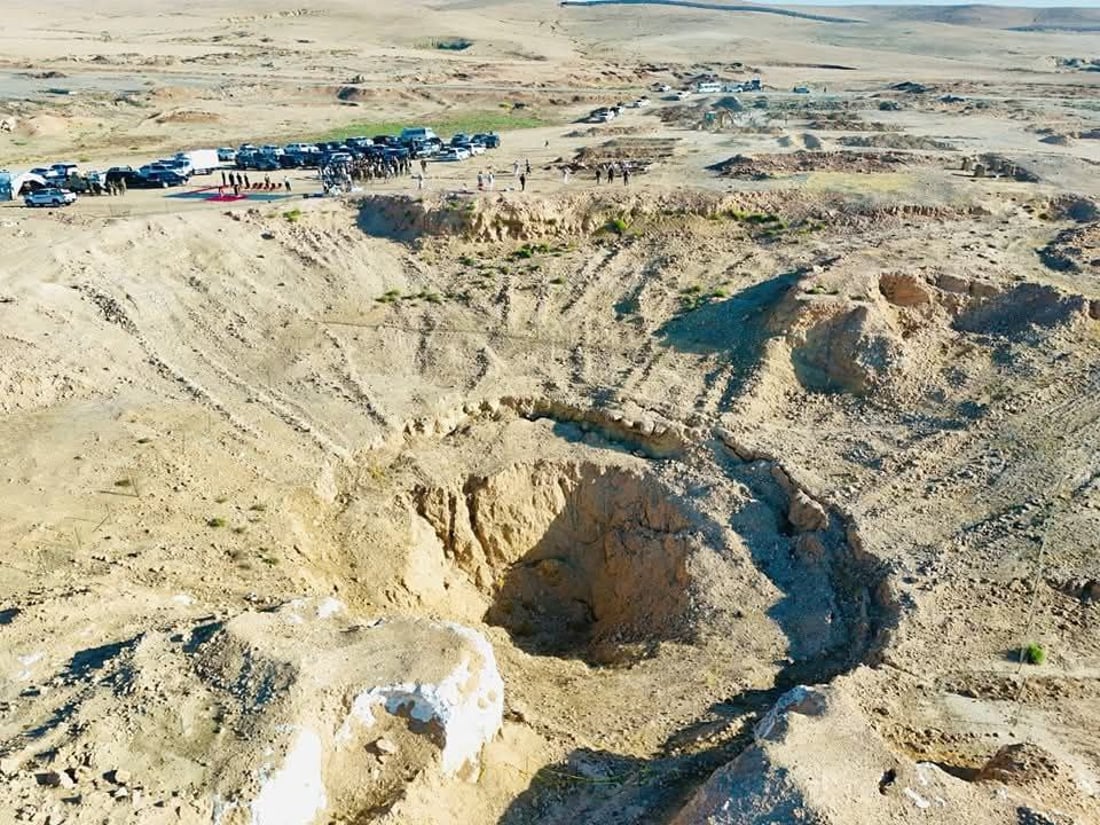
Excavation teams and local officials gather at the edge of Al-Khasfa, a massive sinkhole south of Mosul that ISIS used as a mass grave
Nineveh
Excavation begins at Al-Khasfa, one of Iraq’s largest ISIS mass graves
NINEVEH — Authorities in Nineveh have begun the formal process of excavating Al-Khasfa, a vast sinkhole south of Mosul that ISIS turned into a mass grave during its rule, in an effort to document crimes, recover remains, and secure the rights of victims’ families.
Governor Abdul Qader al-Dakhil and Judge Raed Hamid al-Muslih, head of the Nineveh Court of Appeals, announced the launch on Sunday. “The aim of this step is to document the crimes and secure the rights of the martyrs and their families, under legal and humanitarian frameworks, and under the supervision of judicial, security, medical and technical authorities,” al-Dakhil’s office said in a statement.
Speaking at a press conference near the site in the al-Adhba area, al-Dakhil said nearly 20,000 people from Mosul and across Nineveh were executed by ISIS and thrown into the pit. “ISIS executed thousands of Nineveh residents without distinction, including Yazidis, Christians, Shabak and Turkmen,” he said. He added that more than 2,000 people were killed in a single day, including 600 from the Wadi Hajar neighborhood.
The governor described Al-Khasfa as a “bizarre biological site” that still conceals many unknowns. He said initial steps have been taken to establish a Directorate of Mass Graves with support from Judge al-Muslih to begin documenting and recovering remains.
Iraq’s Supreme Judicial Council announced in March the allocation of 40 billion dinars ($27 million) to fund the excavation, which officials estimate could take up to five years. The site is about 150 meters deep and 110 meters across, and is believed to contain the remains of between 15,000 and 20,000 victims, including Yazidis, Christians, Turkmen, Shabak, and members of the security forces.
Al-Dakhil has called Al-Khasfa “the largest mass grave in the world,” recalling that in 2016 ISIS executed 280 Interior Ministry personnel there in a single day. He said the project aims not only to identify remains and document crimes but also to lay the groundwork for a memorial to honor the victims and reinforce efforts against extremism.