
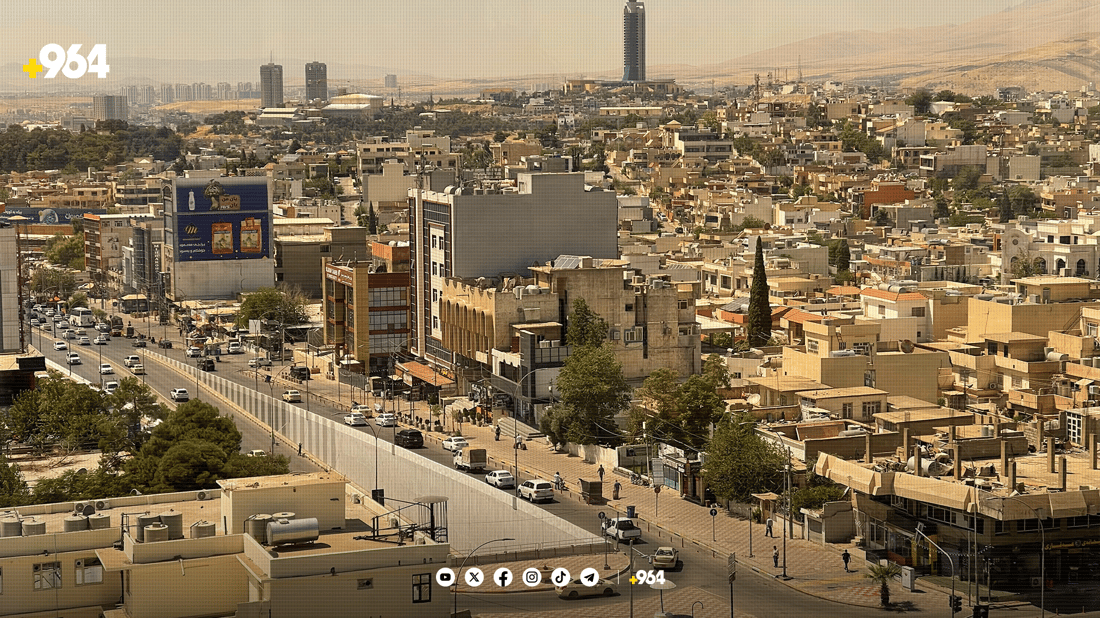
A view of central Sulaymaniyah during peak summer heat. Photo by 964media.
'No year has been as bad as this'
Water crisis deepens in Sulaymaniyah as shortages stretch to five days in some areas
SULAYMANIYAH — Worsening water shortages across Sulaymaniyah have left many neighborhoods without piped water for up to five days at a time, disrupting daily life, closing mosques, and driving up the cost of tanker-delivered water amid rising summer temperatures.
Amanj Jalal, spokesperson for the Sulaymaniyah Water Directorate, told 964media that the primary cause is a sharp decline in water levels at Sirchanar, one of the city’s main water sources.
“Eighty percent of Sirchanar’s water is gone,” he said. “Because of that, we’ve had to extend the supply intervals to once every four days, and in some areas, even five.”
Jalal said the city requires 480,000 cubic meters of water per day but is currently able to supply only around 250,000. Authorities are now depending on Dukan’s lines one and two along with the remaining output from Sirchanar.
He urged residents to conserve water, avoid waste, and install rooftop storage tanks. “We ask everyone to understand the gravity of the situation and do what they can to help,” he said.
The shortage has forced closures of key religious and community spaces. For more than a week, two major mosques — including Rasul Mosque in the Bakhtyari neighborhood — have remained closed except for brief openings around prayer times to allow for ablution. Notices posted on the gates read: “Closed due to lack of water.”
The crisis follows an unusually dry year across the Kurdistan Region. As of early May, Sulaymaniyah had recorded just 350 millimeters of rain, down from 671 millimeters the previous year. Rainfall also dropped dramatically in Erbil and Duhok, where levels fell from over 580 and 620 millimeters respectively to under 160 in both governorates.
Despite the decline, Kurdistan Region officials have maintained that water distribution programs have not changed.
“There are no changes to the water distribution schedule,” Ari Ahmed, head of the region’s General Directorate of Water and Sewerage, told 964media in May. “People should install rooftop tanks and avoid excessive use.”
Still, residents say the strain on households is growing. In the Hawara Barza neighborhood, locals held a protest Friday after going 21 days without piped water.
“Even the water we get is murky and unusable,” one resident said. “We haven’t seen a year like this before.”
The shortage has driven up demand for private water tankers, a more costly alternative that many families cannot afford. Osman Mohammed, a driver for a state-run tanker service, said requests have surged.
“I have a long list of customers waiting for deliveries,” he said.
Tanker water typically costs between 15,000 and 20,000 dinars ($10.80 to $14.40), but Mohammed said some private suppliers are now charging as much as 75,000 dinars ($54) per load.
“No year has been as bad as this,” another resident said. “Even when the water comes, it barely trickles into our rooftop tanks.”