
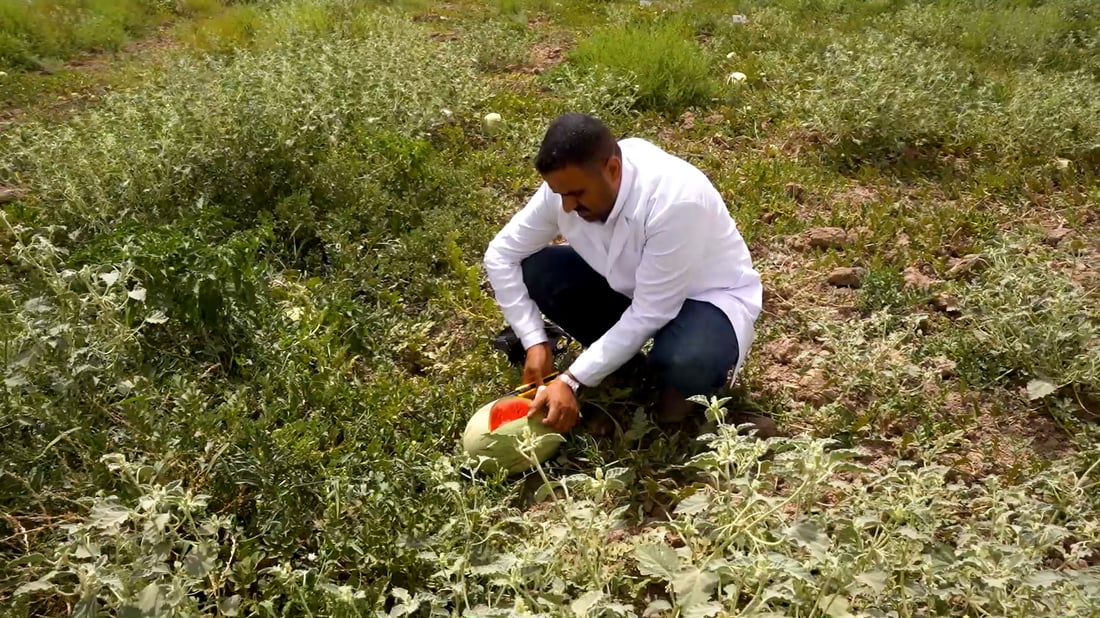
A researcher from the University of Anbar’s College of Agriculture examines a grafted watermelon in a test field in Albu Bali, east of Ramadi, where scientists are testing disease-resistant techniques using squash rootstock and biofertilizers. Photo by 964media
University of Anbar researchers develop fusarium-resistant watermelon grafts
ANBAR — Agricultural researchers at the University of Anbar have successfully developed a method to protect watermelon crops from fusarium wilt, a fungal disease that threatens yields during Iraq’s peak summer season.
The team, based at the university’s College of Agriculture, grafted watermelon plants onto squash rootstock in test plots in the Albu Bali area east of Ramadi. Instead of chemical inputs, they used biofertilizers to support plant health and sustainability.
“We achieved a clear success in cultivating watermelon, which is one of the most in-demand summer fruits in Iraq,” said Idham Ali, dean of the college. “This crop faces several challenges, most notably fusarium during June and July, which causes the plants to wilt before the fruit matures and leads to major losses for farmers.”
Ali said the squash rootstock enhanced the plant’s resistance to fusarium, drought, and soil salinity, allowing the fruit to survive through vulnerable stages of growth. The use of biofertilizers, he added, helped reduce the environmental impact and ensured a safer harvest.
The grafted watermelons produced firm, sweet red fruit with consistent size and high resistance to disease, according to the team.
Lead researcher Mohammed Ahmed said the idea arose from the observation that watermelon plants experience poor vegetative growth during the hottest months of the year, making them more susceptible to fungal infections.
“But the squash roots used in grafting showed strong resistance to wilt-causing diseases and to soil salinity, which is a major issue in Iraq,” he said.
The experiment was conducted on a one-dunam plot and yielded fruit with deeper green rinds and no differences in flavor or texture compared to traditional watermelon varieties.
“This was the first experiment of grafting watermelon onto squash in Anbar, and it produced excellent results,” Ahmed said.