
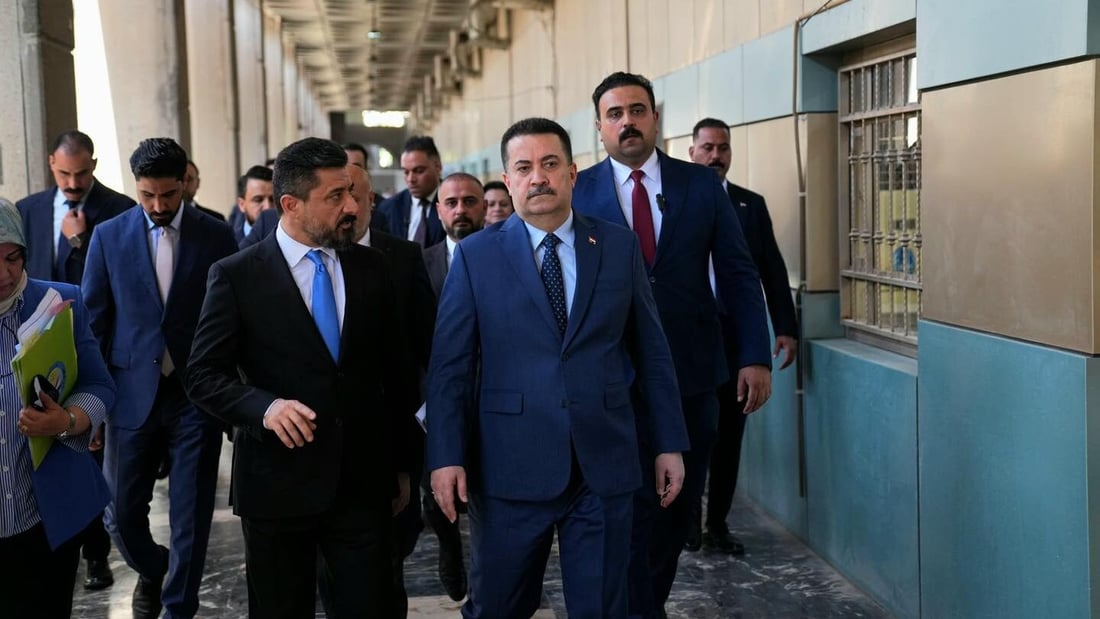
Prime Minister Mohammed Shiaa Al-Sudani visits the Ministry of Justice in Baghdad to review correctional facility operations and employee service programs.
Monitor
Al-Sudani emphasizes rehabilitation role for prisons during Justice Ministry visit
BAGHDAD — Prime Minister Mohammed Shiaa Al-Sudani on Sunday emphasized the need for Iraq’s correctional facilities to serve as centers for rehabilitation, not just confinement, during a visit to the Ministry of Justice and the Real Estate Registration Directorate in Baghdad.
During his tour, Al-Sudani reviewed the condition of correctional facilities and called for action to reduce overcrowding and introduce education and literacy programs for inmates. The PM highlighted the importance of transforming prisons into spaces that support rehabilitation and reintegration, according to a statement from his media office.
Iraq’s prison system has long faced criticism for overcrowding and poor conditions. Justice Minister Khalid Shwani previously stated that overcrowding would be resolved by 2026, but the Justice Network for Prisoners in Iraq has labeled 80% of facilities “unfit for life.” Human rights monitors report that nearly 70,000 inmates are currently held in under 30 facilities, with issues such as inadequate healthcare, poor hygiene, and a lack of separation between inmates of differing criminal backgrounds contributing to health crises and security problems.
Full statement from Al-Sudani’s office:
Prime Minister Mohammed S. Al-Sudani conducted a visit today, Sunday, to the Ministry of Justice and the Real Estate Registration Directorate. He affirmed that his visit stems from the vital role the Ministry plays in providing services, as its departments are among the most directly engaged with citizens.
His Excellency toured the sections of the Real Estate Registration Directorate, where he met with a group of citizens and listened to their comments and needs. He also reviewed the workflow across all service and administrative stages.
During his visit, Prime Minister Al-Sudani emphasized the need to proceed with a full transition to automation and electronic operations to facilitate citizen services, expedite transaction processing, eliminate obstacles and bureaucracy, combat corruption, and reduce pressure on employees. He stressed that this initiative stems from the principle of a service-oriented government—an approach that is not merely a slogan, but a recognition of the importance of enhancing services to restore public trust in institutions.
His Excellency pointed to the issue of overcrowding in Ministry of Justice departments due to a shortage of buildings in Baghdad and other provinces. He underscored the importance of implementing electronic signatures for processing citizen paperwork, noting that there are those who seek to obstruct progress and maintain the status quo. He called on department heads to provide effective solutions, particularly in combating corruption, which remains a key criterion in evaluating officials.
The Prime Minister also reviewed the status of the correctional facility, emphasizing the need for it to truly function as a center for rehabilitating inmates by addressing the issue of overcrowding and facilitating education and literacy programs within prisons and correctional facilities. He also confirmed his continued follow-up on the process of allocating land plots for the Ministry of Justice employees and resolving all related obstacles.