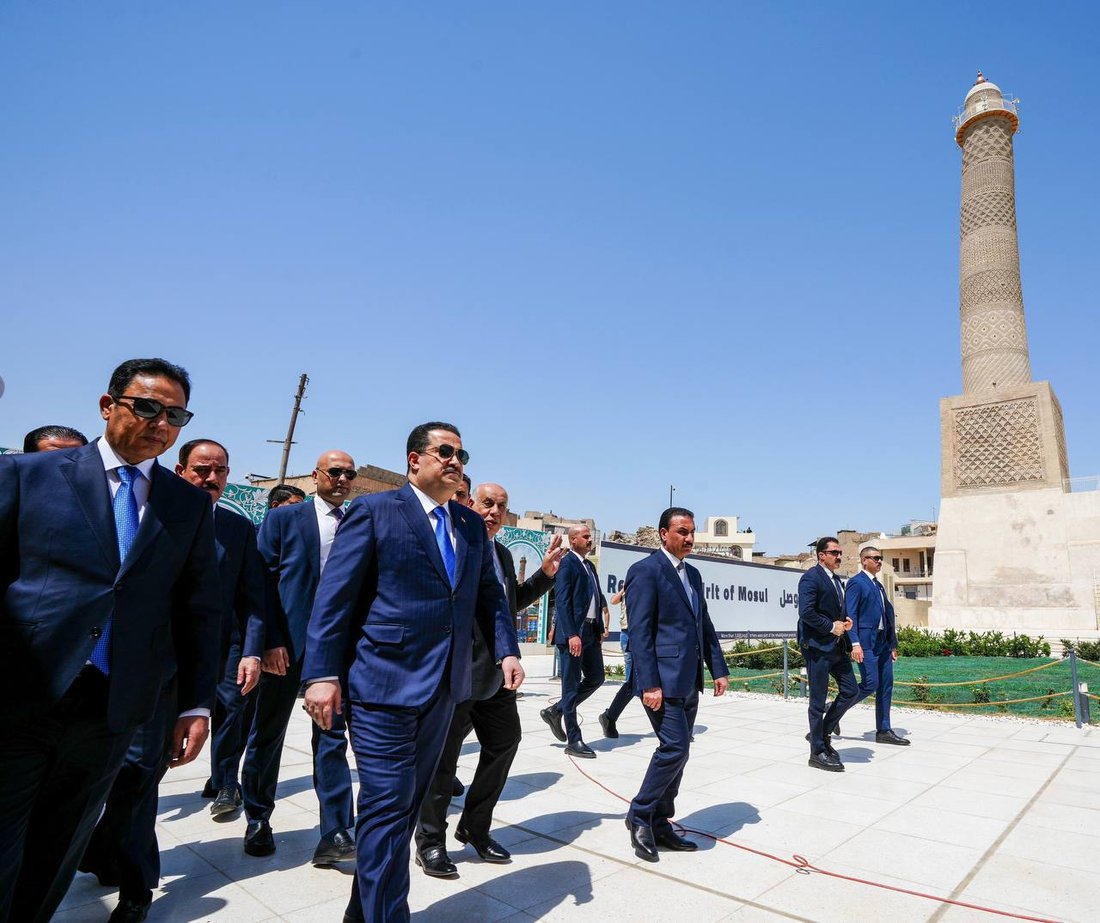
Prime Minister Mohammed Shia Al-Sudani walks with officials during the reopening of Mosul’s Great Al-Nuri Mosque and the restored Al-Hadba Minaret.
'A shining symbol'
Mosul landmarks reopen after reconstruction of Al-Nuri Mosque and historic churches
MOSUL — Prime Minister Mohammed Shia Al-Sudani on Monday inaugurated the reconstructed Great Al-Nuri Mosque and its iconic leaning Al-Hadba Minaret in Mosul, eight years after ISIS destroyed the centuries-old landmarks. He also reopened the Dominican Clock Church and the Syriac Catholic Al-Tahira Church as part of the UNESCO-backed “Revive the Spirit of Mosul” initiative, supported by the United Arab Emirates and Iraqi institutions.
Al-Sudani hailed the restoration of Al-Nuri Mosque as a milestone. “The reconstruction of Al-Nuri Mosque and its minaret will remain a milestone reminding us of the heroism of Iraqis and their defense of their land,” he said. He called the mosque “a shining symbol of Islamic civilization in Iraq and a living witness to our people’s humanitarian journey, crowned by peaceful coexistence and continuous brotherhood among all segments of our society.”
Built nearly 900 years ago under Nur ad-Din Zengi, Al-Nuri Mosque became a cultural and spiritual center for Mosul. Its leaning minaret, known as Al-Hadba, stood as a city landmark until ISIS militants blew it up in June 2017 during the battle to retake Mosul. Al-Sudani said the destruction “was an attempt to kill the spirit of Mosul and cut its connection to its honorable history.”
He added that the demolition of both Al-Nuri and Nabi Yunus Mosques “represented the peak of moral decline by terrorism,” but said their reconstruction sends a message that “Iraqis can restore all that was ruined by the forces of darkness.” He thanked the UAE, UNESCO, the Ministry of Culture, the Sunni Endowment, Mosul’s governorate, and Iraqi and international experts for their roles in the restoration.
Later, Al-Sudani inaugurated the Clock Church, built in the 1870s by Dominican friars, and the Syriac Catholic Al-Tahira Church, one of Mosul’s oldest and largest. Both were destroyed during ISIS’s occupation. He said their reopening “represents houses where people’s hearts gather without discrimination,” describing them as “landmarks of Iraq’s original Christian presence in Nineveh, connected to all other communities in the governorate.”
“The terrorist campaign of 2014 targeted churches and mosques alike,” he said. “Terrorists thought that destroying houses of God would erase the history of coexistence, but the result was the opposite. The reconstruction of Al-Tahira has become a living story of revival, and a symbol of spiritual and architectural rebuilding. Iraq’s diversity is a shield protecting unity, sovereignty, and security.”