
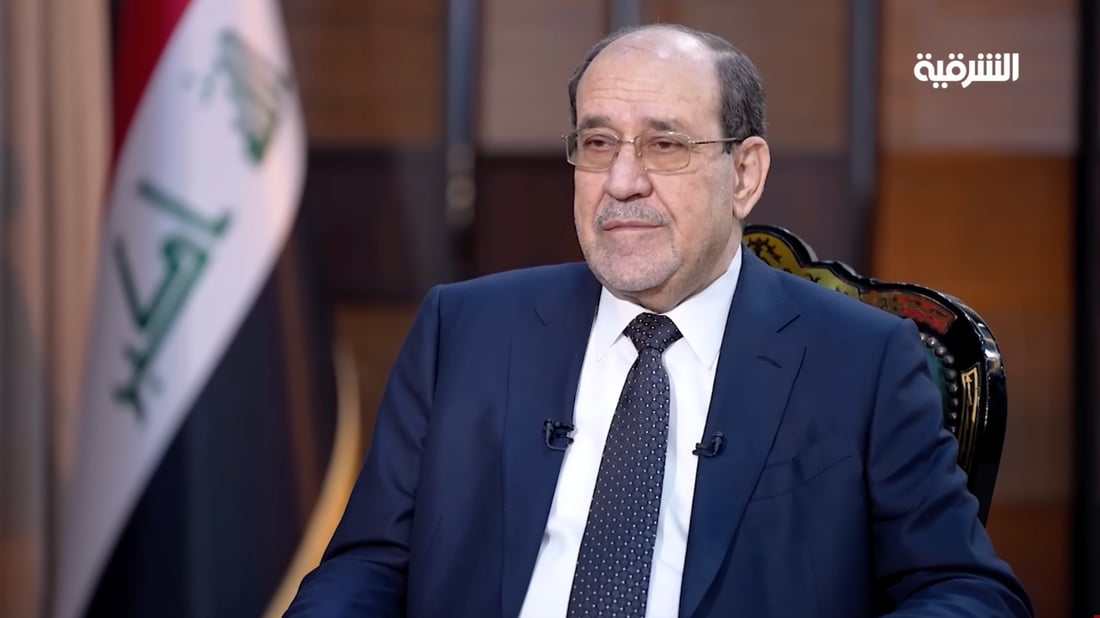
Former Prime Minister Nouri al-Maliki speaks during a televised interview on Al Sharqiya
Media Monitor
‘Does he know me?’: Maliki says US president was ‘misled’ on nomination
BAGHDAD — Former Prime Minister Nouri al-Maliki said President Donald Trump does not know him personally and suggested misinformation led to a social media post opposing his nomination for a third term.
“Does Trump know me to tweet about me?” al-Maliki said during a televised interview on Al Sharqiya, his first public appearance since the Shiite Coordination Framework nominated him for prime minister. He said his name reached Trump through “informants from inside Iraq or outside it,” adding, “I believe there was a process of misleading Trump.”
Trump posted his opposition Feb. 1 after the framework, Iraq’s largest parliamentary bloc, announced al-Maliki as its candidate following the Nov. 11 elections. The coalition rejected Trump’s position, calling the choice of prime minister “a purely Iraqi constitutional matter” decided by majority vote. Al-Maliki, who served as prime minister from 2006 to 2014, also rejected the post, saying external interference is unacceptable.
Al-Maliki said he trusts U.S. institutions and sought to reassure Iraqis worried about economic sanctions if he returns to office, calling such warnings “a process of intimidation.” He said U.S. statements after the post were “not tense or extreme.”
“I received a lot of information about Trump’s tweet and learned many of its backgrounds,” al-Maliki said. “But I say: does Trump know me? Is there a previous relationship between me and him? I have no relationship with him.”
He said three countries intervened through reports and channels, claiming they warned his return would destabilize another state. “There are those who say the tweet was written by Iraqi hands. I neither confirm nor deny this,” he said.
Al-Maliki said he remains committed to working with Washington. “I am the one who signed the Strategic Framework Agreement for partnership between us and the United States,” he said.
The U.S. charge d’affaires visited him twice, al-Maliki said. The first visit conveyed that Washington would not interfere in who is nominated for prime minister. “He went to the rest of the brothers in the Coordination Framework and conveyed the same decision, that this is an Iraqi matter,” al-Maliki said. After the post, the envoy confirmed it came from Trump and cited U.S. interests.
On armed factions, al-Maliki ruled out a military campaign similar to the 2008 “Charge of the Knights” operations he launched against militias in Basra and Baghdad.
“I will not carry out another Charge of the Knights against the factions. These are our sons and friends,” he said.
He said the groups want reassurance they will not be targeted after disarmament and seek real participation in government. “They want guarantees of genuine partnership in the state,” al-Maliki said, adding that his relationships with the factions could help resolve the weapons issue through dialogue.
Weapons outside government control remain central to Iraq’s political negotiations. U.S. officials have pressed Iraqi leaders to dismantle armed groups, linking the issue to sovereignty and regional stability. Armed factions have rejected disarmament, saying such steps should follow full sovereignty and an end to foreign presence.