
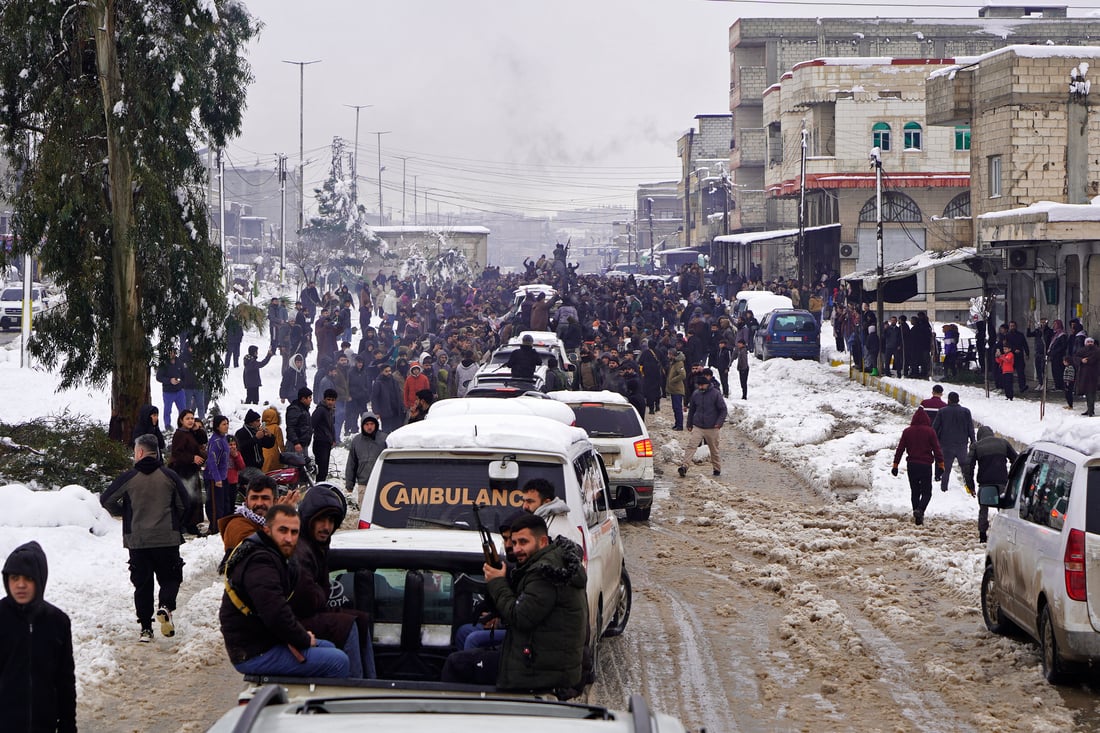
Fighters from the Kurdish-led Syrian Democratic Forces arrive at the Kurdish-held city of Kobani after they withdrew from the Al-Aqtan prison in the Raqqa (Photo by AFP)
‘We know what awaits’: Kobani residents reject ‘humanitarian corridors’
KOBANI, Syria — 964media
Residents of Kobani and nearby towns said they reject newly announced “humanitarian corridors” proposed by the Syrian Interim Government, describing them as dangerous and untrustworthy amid what they said is an ongoing siege and intense military pressure on the city.
More than 25 residents from neighborhoods across Kobani and surrounding communities spoke to 964media on condition of anonymity. Several said the corridors, one announced for Kobani and another for Hasakah, amount to a threat rather than a protective measure.
“These corridors are not for our protection,” said one resident from Kaniya Kurdan. “They are a trap, and everyone here knows it.”
Residents said Kobani is severely isolated, describing a military encirclement that has limited movement and resources. Under those conditions, they said, statements issued by authorities linked to the forces surrounding the city are viewed through the lens of survival rather than as humanitarian steps.
“There is no trust left,” said a resident from Shahid Botan. “We look at what has happened before, not what they say now.”
Kobani is predominantly Kurdish, with the presence of non-Muslim minorities. Residents said many people in the area are internally displaced and previously fled violence in places captured by factions affiliated with Syria’s Ministry of Defence.
These factions, according to residents, are responsible for previous killings and abuses targeting Kurdish civilians.
“We ran from these same people before,” said a resident in Azadi Square. “Why would we believe their promises now?”
Residents also described the composition of forces surrounding Kobani, saying fighters previously affiliated with the so-called National Army are present and claiming that some have adopted ISIS insignia and slogans.
“They carry the same black flags, use the same words,” said a resident from Shuyoukh. “We see them. We hear them.”
Several residents said they fear ethnically and religiously targeted violence, citing reports that some fighters are under international sanctions for war crimes and human rights violations.
“They’ve taken others before, men, women, children,” said a resident from Ain Bata. “They won’t spare us if we go through those corridors.”
Residents pointed to what they described as a pattern of abuse against Kurdish populations in Afrin, Aleppo and Ras al-Ain as evidence they cannot trust corridors controlled by forces they associate with the Ministry of Defence. They cited alleged extrajudicial killings, kidnappings for ransom, forced displacement, property seizures and demographic changes.
“What they did in Afrin, they want to do here,” said a resident in the city center. “This is not new to us.”
Residents also cited rhetoric they attributed to Syria’s Ministry of Awqaf, saying comments invoked language reminiscent of the Anfal campaign, a term associated with genocidal operations against Kurds in Iraq.
“They are calling us infidels,” said a resident from Jalabiya. “We’ve seen the videos. They want us gone.”
Videos circulating online appear to show armed men residents associate with the Ministry of Defence threatening Kurds with death while using religious language to justify violence.
Against that backdrop, residents said they reject the corridors as lacking neutrality, oversight or any credible guarantees.
“We would rather die here than walk into a corridor they control,” said a resident from Tal Ghazal. “They offer no safety, no guarantee.”
Residents said they fear abduction, killing or humiliation if they attempt to use the corridors.
Instead, residents called for what they described as full implementation of the Jan. 18 agreement and outlined demands they said would be necessary for their safety, including an immediate ceasefire and de-escalation, the withdrawal of Ministry of Defence factions from Kurdish areas, mechanisms to secure local safety and international or independent guarantees for Kurdish and non-Sunni communities.
“We need monitors, real ones, not more empty words,” said a resident from Salam Square. “Only then will we feel safe.”
Residents said the corridor plan, announced under current conditions, is not viewed locally as a safe passage but as a threat.
“This is not politics,” said a resident from Shiran. “It’s about survival. We know what awaits outside.”