
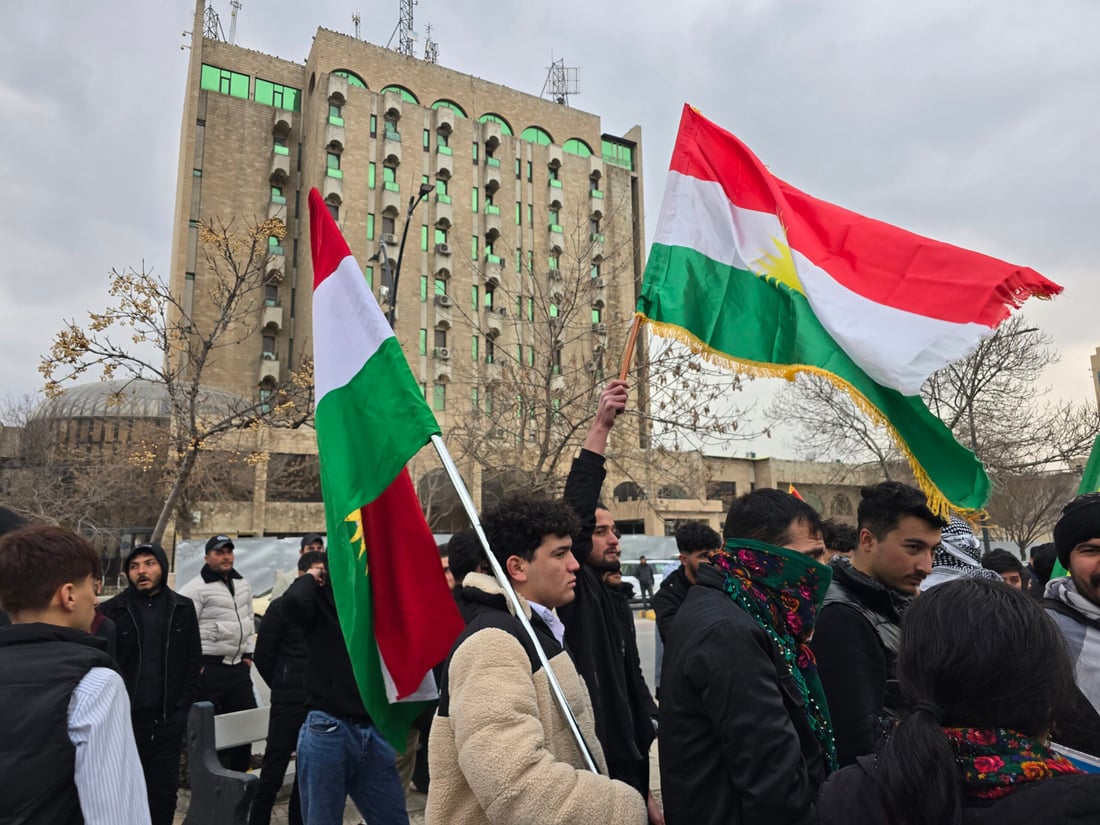
Protesters carry the Kurdistan Region flag during a demonstration in Sulaymaniyah in support of Syrian Kurds, Jan. 19, 2026. (Photo: 964media)
Sulaymaniyah protest condemns attacks on Kurdish areas in Syria
SULAYMANIYAH — Activists and residents in Sulaymaniyah gathered Monday to protest military assaults by Syrian government forces and allied armed groups on Kurdish-held areas in northeastern Syria, denouncing what they described as attempts to forcibly dismantle Kurdish self-rule and target civilian communities.
The demonstration focused on attacks against Kurdish neighborhoods and positions held by the Syrian Democratic Forces, which have controlled parts of northern and northeastern Syria for years and played a central role in the fight against the Islamic State group.
Protesters said the military operations go beyond political disputes and amount to an assault on Kurdish identity and existence in the region.
“What is happening now in Western Kurdistan is not a simple political disagreement,” one participant said. “It is an attempt to erase the identity of an entire people.”
She called on Kurds and supporters worldwide to speak out, saying, “Every individual, whether in Kurdistan or elsewhere in the world, has a moral and humanitarian responsibility to oppose and condemn the international community’s silence toward these actions against Kurds in Rojava.”
Participants chanted slogans including “Long live Rojava’s resistance” and expressed support for Syrian Kurds and the Syrian Democratic Forces, praising what they described as a model of coexistence, protection of women’s rights and defense of minority communities.
Syrian Kurds have administered large areas of northern and northeastern Syria for more than a decade under a self-governing system backed by the SDF, which was a key partner in the U.S.-led coalition that defeated the Islamic State’s territorial control in 2019.
In January 2026, Syria’s transitional authorities and allied armed factions launched a new military campaign against Kurdish-held areas, advancing into territory around Aleppo and other regions previously under SDF control. The offensive displaced civilians, triggered international concern and drew condemnation from Kurdish leaders, who warned of demographic change and ethnic targeting.