
Daily currency exchange rates
Monitor
Advisor to Iraqi PM says exchange rate swings are ‘temporary’
BAGHDAD — Prime Minister’s financial adviser Mazhar Mohammed Salih said Sunday that recent fluctuations in the exchange rate are “temporary” and do not reflect a structural imbalance in Iraq’s economy, as the U.S. dollar has continued to rise against the Iraqi dinar in the parallel market for more than a week.
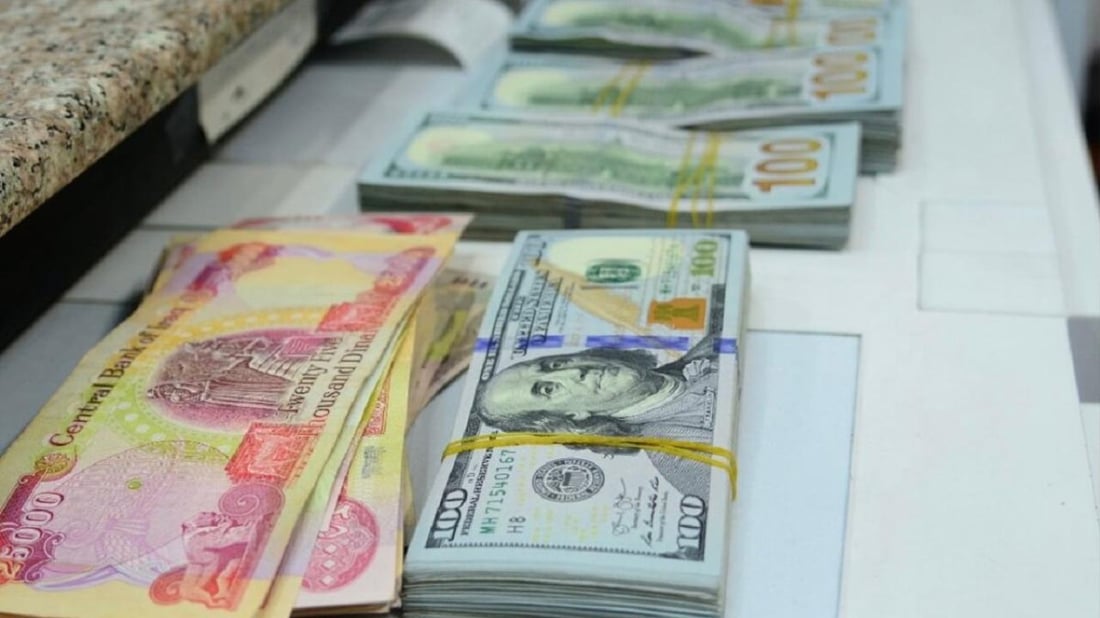
In the parallel market, the dollar has traded at higher levels than the official rate in recent days. On Monday, $100 sold for about 147,000 dinars in Baghdad and Basra, while buying rates stood at 146,250 dinars. In Erbil, $100 sold for around 145,500 dinars and bought at 145,400 dinars, according to local market data.
The Central Bank of Iraq’s official rate, used in official transactions, banking and international trade, remains fixed at 1,320 dinars per dollar, more than 100 dinars below the street rate.
Salih told the state news agency that the exchange rate volatility is “temporary and does not reflect a structural imbalance, especially since it has practically separated from income and consumption levels, with its impact shifting to the asset sector, which is not directly linked to the stability of daily living.”
He said that “the limited fluctuations witnessed in the parallel exchange market are nothing more than temporary and non-influential reactions,” adding that they came in response to the launch of a recent financial discipline package.
That package included decisions aimed at reviewing public spending pathways and enhancing public revenue efficiency, “particularly with regard to expanding and regulating tax and customs bases.”
Salih’s statements for the state news agency:
Temporary and does not reflect a structural imbalance, especially since it has practically separated from income and consumption levels, with its impact shifting to the asset sector, which is not directly linked to the stability of daily living. the limited fluctuations witnessed in the parallel exchange market are nothing more than temporary and non-influential reactions,
Such movements are a natural market behavior when receiving new signals from public fiscal policy, as supply and demand forces tend to test these signals and adapt to them temporarily, before returning to more stable paths consistent with the new economic and financial foundations. the temporary fluctuations occurring in the parallel market do not reflect a structural imbalance as much as they represent a temporary adaptation phase to regulatory tools that fundamentally aim to enhance financial and monetary stability in the medium term.
What is observed of fluctuations in the parallel exchange market does not go beyond being movements of limited impact and does not affect the stability of the general price range in our country, which has remained at a low inflation rate of about 2.5% annually.
The first is monetary policy, which adopts a fixed official exchange rate of the Iraqi dinar against the dollar at 1,320 dinars per dollar, providing a stable nominal anchor for prices. The second is fiscal policy, which practices support on a wide scale, as support constitutes nearly 13% of gross domestic product, which mitigates the transmission of price shocks to living standards, especially in basic goods and services.
The third is trade policy in price defense; alongside the subsidized food basket, the modern market system (hypermarkets) has emerged as the qualitative counter to the effects of the exchange market, as it works to absorb what can be called colored noise resulting from confused information in the parallel exchange market, and transform it into stable white noise in terms of prices and consumption.
The parallel exchange market no longer has notable importance in influencing living conditions, after it practically separated from income and consumption levels, with its impact shifting to the asset sector, which is not directly linked to the stability of daily living.