
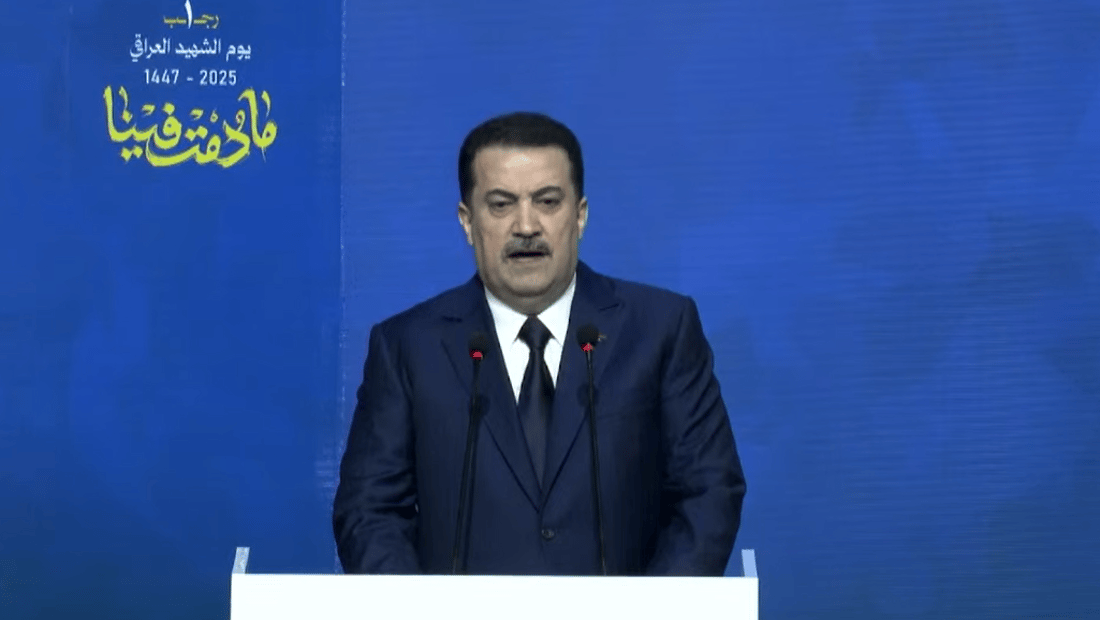
Iraq's Prime Minister Al-Sudani
Media Monitor
Al-Sudani: ‘We call on national forces to resolve constitutional entitlements’
BAGHDAD — Prime Minister Mohammed Shia Al-Sudani attended a memorial ceremony in Baghdad on Saturday commemorating the anniversary of the death of Ayatollah Sayyid Mohammed Baqir Al-Hakim, describing the late cleric as “a supreme symbol of struggle against tyranny and oppression.”
In remarks delivered during the event organized by Al-Hikma Movement, Al-Sudani said the death of Sayyid Al-Hakim represented “a considerable Islamic and Iraqi historical turning point, an intellectual project, and a supreme symbol of struggle.”
Al-Sudani called for protecting Iraq’s national interest through inclusive political cooperation. “We have achieved a transformation that was not limited to services and the economy, but also included major political successes in important strategic files,” he said.
He highlighted the conclusion of the International Coalition’s mission and the end of the UN Assistance Mission for Iraq as “the result of a government program dedicated to Iraq’s sovereignty and the independence of its political decision.”
Statement from Al-Sudani’s media office:
Prime Minister Mohammed S. Al-Sudani attended today, Saturday, the memorial ceremony held by the National Wisdom Movement in the capital, Baghdad, marking the anniversary of the martyrdom of Ayatollah Sayyid Mohammed Baqir Al-Hakim.
The Prime Minister affirmed that commemorating this occasion carries profound spiritual and intellectual significance, noting that the martyred Sayyid Al-Hakim represented a considerable Islamic and Iraqi historical turning point, an intellectual project, and a supreme symbol of struggle against tyranny and oppression. He embodied the meaning of martyrdom through his firm belief that Iraq is a homeland for all its people, without discrimination or exclusion.
Prime Minister Al-Sudani emphasized the necessity of safeguarding the national interest through genuine partnership among political forces, prioritizing the interests of the Iraqi people by representing their voices and fulfilling their aspirations. He noted that the past three years have witnessed an exceptional course of action, one that is not merely an achievement of the government, but of Iraq, its people, and its national forces.
The following are the key points from the Prime Minister’s speech:
🔷 We have achieved a transformation that was not limited to services and the economy, but also included major political successes in important strategic files.
🔷 The conclusion of the mission of the International Coalition and the end of the mandate of the United Nations Assistance Mission for Iraq (UNAMI) are the result of a government program dedicated to Iraq’s sovereignty and the independence of its political decision.
🔷 We launched engagement with the regional and international environment as a fully sovereign state, with solid constitutional institutions and armed forces capable of safeguarding the country’s security.
🔷 The world has acknowledged the significance of the achievements made in state-building and the strong response to the demands of our people.
🔷 The turnout in the elections was a response by our people to the results achieved through implementing government priorities under a state-building approach that places Iraq first.
🔷 Active electoral participation represented an important turning point upon which we can build the features of the next phase, to consolidate the democratic path.
🔷 We call on national forces to resolve constitutional entitlements, stemming from their responsibility toward the supreme interests of the country.
🔷 We will continue the development process that has achieved much, with more still ahead of us.
🔷 The wheel of construction, reconstruction, and development is moving forward with scientific planning and responsibility, supported by constructive partnerships with brothers and friends.
🔷 The Martyr of the Mihrab (Sayyid Mohammed Baqir Al-Hakim) devoted his life to struggle so that we may live this moment today, in a new Iraq, sovereign and independent in its national decision.