
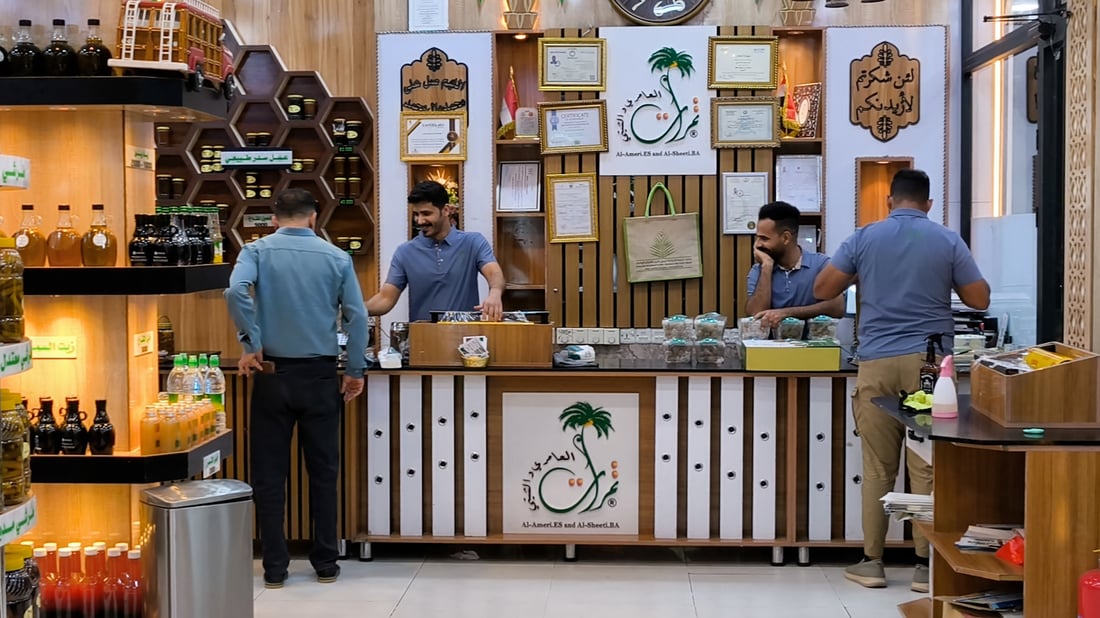
Staff at Al-Amiri and Al-Sheti Dates Company assist customers at their shop in Abu Al-Khasib, Basra, where locally made date products such as ma’moul and ma’assal are displayed. (Photo by 964media)
Basra’s ‘palm wedding’ season yields new date-based sweets and spiced delicacies
BASRA — The annual date harvest in Abu Al-Khasib, known locally as the “palm wedding,” has evolved beyond pressing premium dates into a season of innovation. Local producers are mixing dates with six aromatic spices — including ginger, anise, and nutmeg — soaking them in syrup and fermenting the blend to create a traditional specialty called ma’assal.
At the same time, date-pressing workshops such as Al-Amiri and Al-Sheti are expanding production and experimenting with new products. Their facilities now convert red and black molasses into white syrup “for decorative purposes” and have introduced a new variety known as “Barma Al-Barhi.”
Date supplies increasingly come from western Basra following the success of palm groves across the desert areas near Al-Zubair.
Naeem Al-Sheti, marketing director of Al-Amiri and Al-Sheti Dates Company, said the business, founded in 1991 by two families in the Saraji area, is among Abu Al-Khasib’s oldest. “We represent a heritage identity,” he told 964media. “In 2014, we began producing modern products such as ma’moul pastries filled with dates. In winter, demand is highest for makbous, date ma’assal, and Barma Al-Barhi.”
Al-Sheti said the company combines traditional craft with innovation. “Gulf countries dip dates in chocolate and coat them with nuts,” he said. “We mash the dates, stuff them with walnuts, add six kinds of spices, and preserve them in a way that keeps them fresh for more than six months. These spices improve digestion, flavor, and texture.”
The company produces more than 75 types of date sweets and ma’moul in various sizes, sold through its showroom. Date ma’assal is made in two main styles — one with pits and another filled with nuts — and each comes with either white or black syrup.
“The syrup differs from natural molasses,” Al-Sheti explained. “It’s lighter and heat-treated through a centrifugal process that turns black molasses into white syrup.”
The company’s busiest periods are winter and Ramadan. “Ramadan, which will fall in the second month of next year, is our best season,” Al-Sheti said. “We’re ready for both. Generally, the date season runs from November through mid-March.”
He added that between mid-October and early December, customers often buy makbous as gifts for relatives abroad. “We don’t have shipping services outside Iraq, but travelers take our dates with them,” he said. “Inside Iraq, we deliver to all governorates from north to south.”