
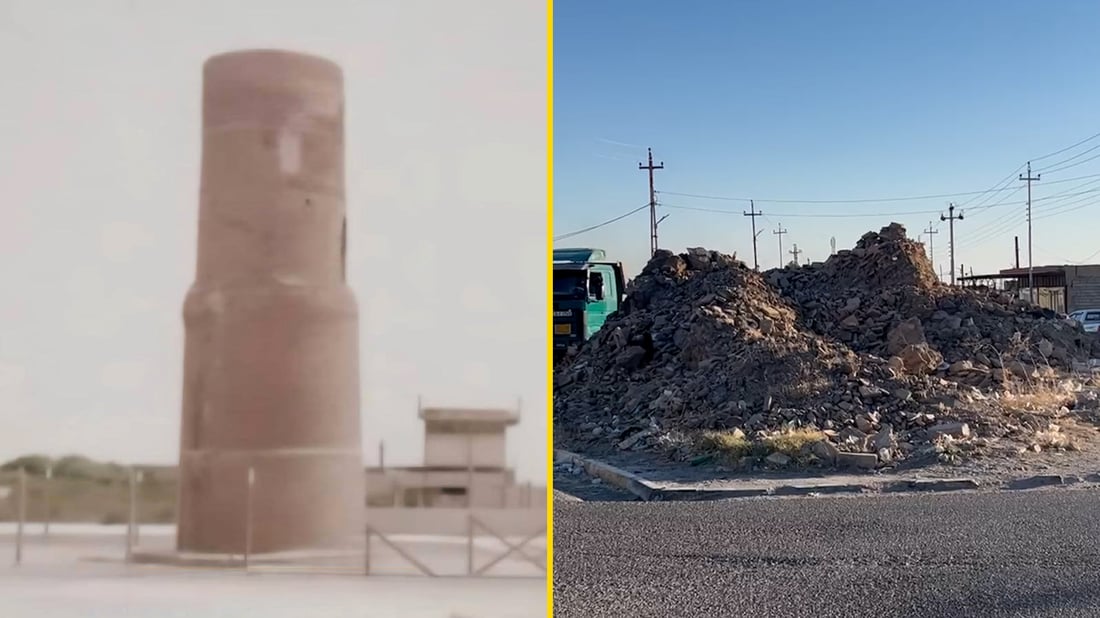
Sinjar residents call for restoration of historic minaret after success of Mosul’s al-Hadba
SINJAR — Residents of Sinjar are urging local and international authorities to launch a reconstruction campaign for the city’s historic minaret, often described as a twin to Mosul’s al-Hadba, following the successful restoration of the latter by Iraqi and Emirati teams in partnership with UNESCO.
The Sinjar Minaret, dating back to the 12th century and built during the Atabeg era under Nur al-Din al-Zangi, was heavily damaged during years of war and the occupation of the area by ISIS. Despite the destruction, officials say many of the original materials remain on-site, raising hopes that the structure can be authentically rebuilt.
Amir Saleh, director of Sinjar’s municipal projects, said the site has not been cleared and retains much of its original stonework. “The site is completely destroyed, but the original materials are still there and have not been removed,” he told 964media. “The minaret needs restoration, just like al-Hadba. It also requires financial allocations and support from both local and central governments, in addition to international and local organizations.”
Local historian Shakr al-Dakhy emphasized the architectural and historical parallels between Sinjar’s and Mosul’s iconic towers. “The Sinjar Minaret was built at the same time as the al-Hadba Minaret, which was the minaret of Nur al-Din al-Zangi in Mosul. The same materials, engravings, and inscriptions were used,” he said.
He explained that the building material used in the Sinjar Minaret was a type of lime derived from mountain limestone, which was fired, crushed, sifted, and mixed with water. “Once the lime dries, it becomes a solid rock,” he said. “This material, along with stone bricks, formed the structure of the Sinjar Minaret.”
Saleh added that the reconstruction would be carried out under the supervision of the Nineveh Antiquities Inspectorate and follow strict preservation guidelines. “The same old materials will be reused after sorting them according to the instructions and procedures of the Antiquities Inspectorate,” he said. “The type of stone used in the minaret is the old brick. No new materials were used.”