
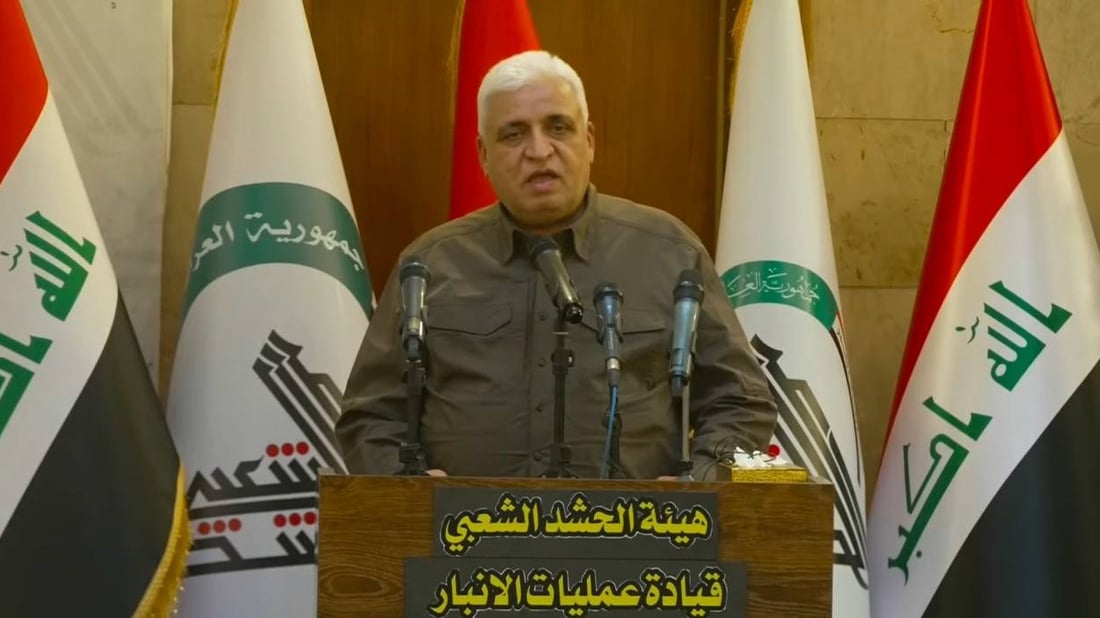
Faleh Al-Fayyadh, head of the Popular Mobilization Forces.
Monitor
Al-Fayyadh says dissolving PMF would be ‘suicide’
BAGHDAD — Popular Mobilization Forces Chairman Faleh al-Fayyadh said dissolving the force would be “suicide,” citing regional conditions he described as comparable to those Iraq faced in 2014 when the Islamic State group emerged.
“Who is the mad man who would say Iraq does not need the PMF amid a volatile regional situation comparable to that of 2014?” al-Fayyadh said in an interview with Dijlah TV.
He said Iraq’s religious authority had not issued directives to disband the force, adding: “If the opinion of the religious authority were to change, I would change my opinion as well.”
Al-Fayyadh said amendments to the PMF law were approved by the Council of Ministers and sent to parliament, emphasizing that the draft is modeled on legislation governing the Ministry of Defense. He rejected comparisons to Iran’s Islamic Revolutionary Guard Corps. “The PMF does not seek to replicate the Iranian experience in Iraq. It is a national formation for all Iraqis,” he said.
He stressed that armed factions were not involved in drafting the law and said the legislation is intended to reinforce the PMF’s position as a formal state force under the authority of the commander-in-chief.
Parliament completed the second reading of the draft law in mid-July, though many Sunni and Kurdish lawmakers walked out in protest at its inclusion on the session’s agenda without consensus. No date has been set for a final vote.
The PMF, also known as Hashd al-Shaabi, was formed in 2014 to fight the Islamic State. While it is officially part of Iraq’s security apparatus, it includes factions with close ties to Iran and varying degrees of independence from the government.
Earlier this year, U.S. Secretary of State Marco Rubio warned Prime Minister Mohammed Shia al-Sudani that the PMF legislation would “institutionalize Iranian influence and armed terrorist groups undermining Iraq’s sovereignty.”
Excerpts from Faleh Al-Fayyadh’s interview with Dijlah TV:
As part of security institution reform plans, completing the legal framework for these institutions is necessary to define rights, duties, and powers, and to limit the space for personal interpretations. The PMF is different from all Iraqi state institutions in terms of its origin, as it was formed and fought without a legal definition. Its presence was jihadist in nature, limited to rescue operations during the early stages of the Islamic State group’s incursion. Later, operations became planned and systematic, leading to daily changes in the PMF’s structure and composition according to the need for new formations and units.
In 2016, the political class agreed to legally define the PMF. A law was passed linking it to the authority of the commander-in-chief of the armed forces.
We submitted our proposed amendments to the PMF law to the Council of Ministers. Since the amendments cover more than half of the current law’s articles, it is considered a new law. The Council of Ministers discussed the necessary amendments, approved them, and forwarded them to parliament. However, significant debate followed regarding the law and the institutionalization of the PMF itself.
The Revolutionary Guard helped us during the liberation battles, and the martyr Hajj Qassem Soleimani personally attended the battlefield as a commander in the Revolutionary Guard. We are honored by this jihadist spirit of the Guard. However, the PMF does not seek to replicate the Iranian experience in Iraq. It is a national formation for all Iraqis, and we have attempted to include all parts of Iraq, except the brothers in the Kurdistan Region, who declined to join.
The new law does not resemble the Revolutionary Guard’s law but rather Iraqi Ministry of Defense laws. Colleagues in the Ministry of Defense participated in drafting the law’s details. We tried to adopt the Ministry’s laws while adding PMF-specific characteristics.
Factions did not participate in drafting the PMF law and are not concerned with it. We at the PMF Commission supervised the draft and submitted it to the Council of Ministers, the legally superior authority. The council discussed the articles and amended some after national dialogue within the council.
Some object to the disciplined PMF and do not recognize the undisciplined ones. Those demanding discipline must provide a code of conduct, specifying powers, uniforms, behavior, camp structure, and so on. Hence, the importance of the law to achieve clarity and allow the commander-in-chief more precise control.
The political class and religious authority aim for the PMF to operate within the framework of the Iraqi state. Factions are a separate matter for which we are not responsible. There is already a separation between the PMF and the factions, though some overlaps exist. The PMF law will reinforce this separation. We have no relation to or opinion about the factions and their positions. We are a formal force obeying the commander-in-chief. If ordered to protect embassies or foreign missions, we will do so, as well as any legal entity requesting our protection.
Some want a disciplined PMF, others do not, and some reject its existence altogether. These are illusions. The PMF derives its legitimacy from the law, religious authority, and society. The law supports us, society upholds us, and the religious authority, despite having notes on some details, has never held a negative stance toward us. If it had changed its view, I would have changed mine too. Who is the mad man who would say Iraq does not need the PMF amid a volatile regional situation comparable to that of 2014?